Floor space is at a premium in manufacturing facilities, and OEMs are being asked to fit more equipment into smaller spaces. FlexLink, part of Coesia and headquartered in Gothenburg, Sweden, is addressing that challenge with robotic palletizing cells designed to protect operators without sacrificing production throughput.
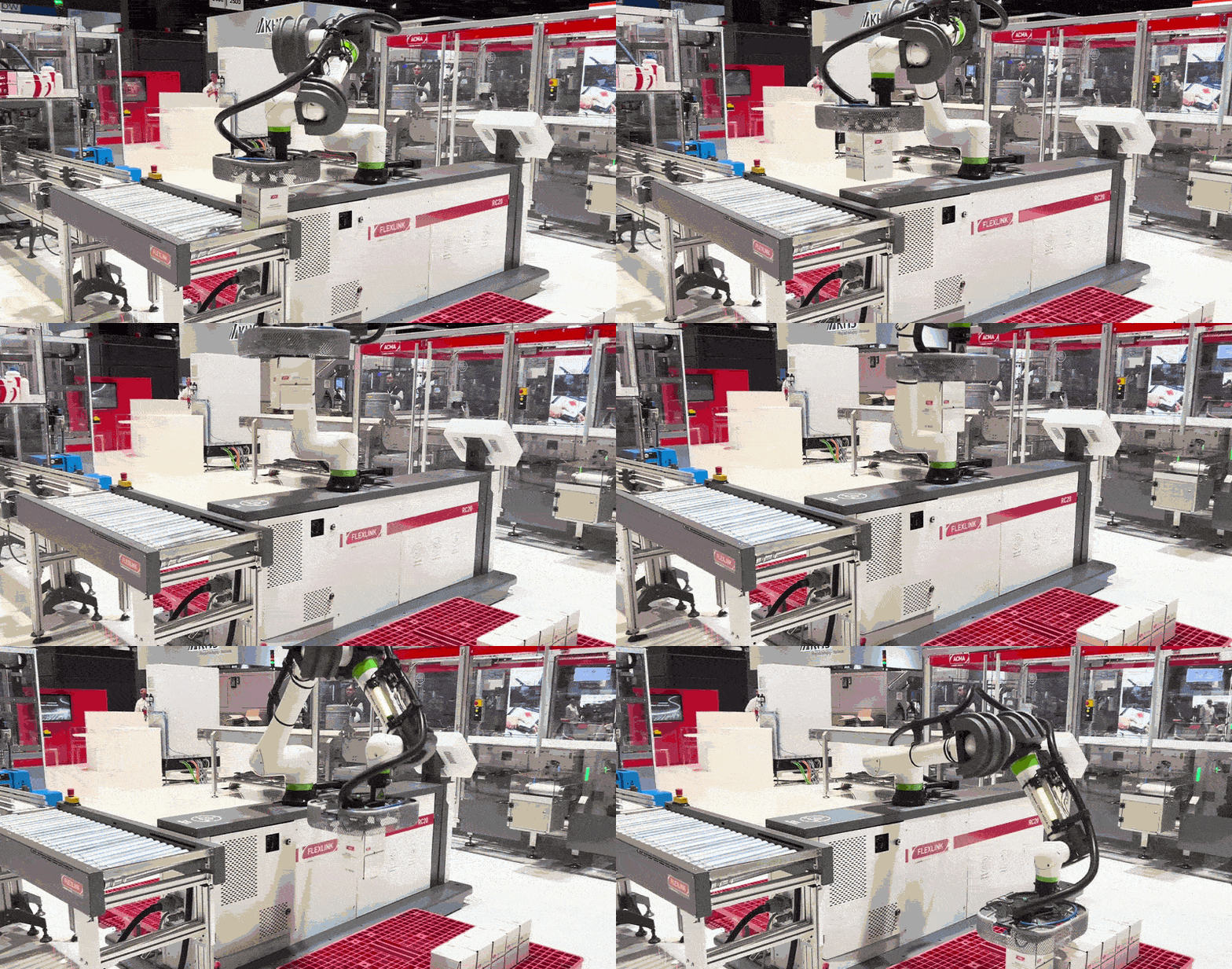
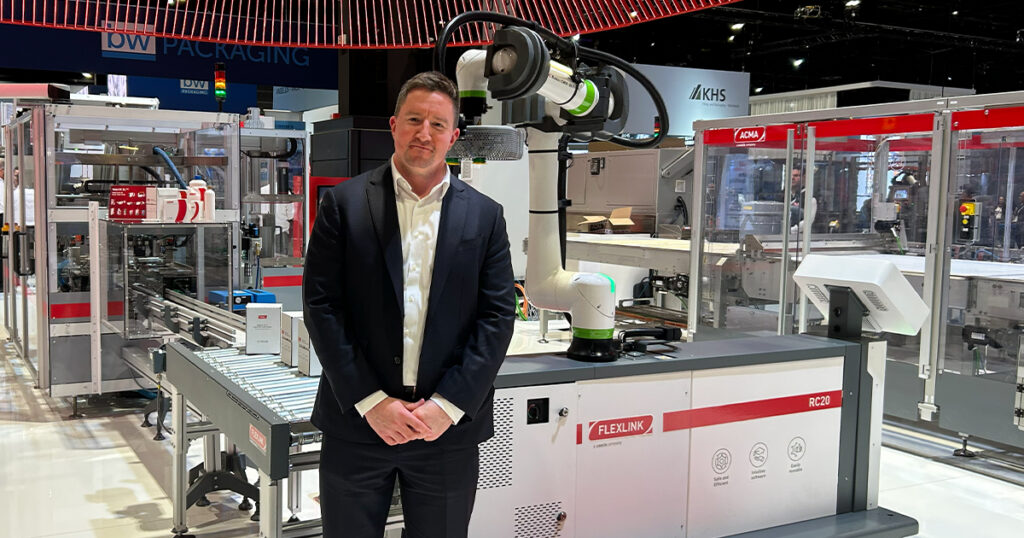
The company’s new RC20 collaborative palletizer is designed for end-of-line operations and uses a FANUC CRX-20iA/L robotic arm, but its safety design extends beyond the robot itself. A detachable end-of-arm safety shroud, contact-sensitive padding, and integrated safety controls provide additional protection without requiring conventional barriers around the cell.
At PACK EXPO International 2026 in Chicago, David Shaw, FlexLink’s head of engineering for North America, explained why designing a safe palletizing cell requires more than selecting a collaborative robot.
“Safety is easy to get wrong on collaborative robotic cells. I always say there’s no such thing as a collaborative robot,” said Shaw. “It’s the cell that is collaborative, and that’s always something that’s definitely got to keep in mind with these things.”
Protecting operators without slowing production
FlexLink designed the RC20 to operate without some of the protective equipment commonly used around industrial robots.
“In packaging, particularly for our end users, the real estate available in factories is at a premium these days. We’re trying to get more and more equipment in a smaller and smaller space,” said Shaw. “Being compact is one of our key parameters to work in.”
Shaw said the system does not require laser scanners, area scanners, or light curtains that may be needed for other robotic applications. This allows operators to move near the palletizing cell without routinely interrupting production.
“People can walk in and around the cell very easily. We don’t inhibit production. We don’t inhibit throughput,” said Shaw.
However, the absence of physical barriers does not mean operators can enter the robot’s working area while it is operating. Shaw said FlexLink uses a task-based risk assessment to determine how people may interact with the equipment and what protective measures are necessary. The RC20’s palletizing area is marked as a designated workspace, but it is not enclosed by conventional fencing.
Shaw described the application as co-existent rather than fully collaborative because operators and the robot do not share the same workspace simultaneously. FlexLink must still account for situations in which someone could enter the operating area.
“But because it’s just a demarcation zone, there’s no physical barriers stopping them. You still have to protect against any foreseeable injury, of course,” said Shaw.
That consideration led FlexLink to incorporate contact-responsive safety features.
Building protection into packaging machinery
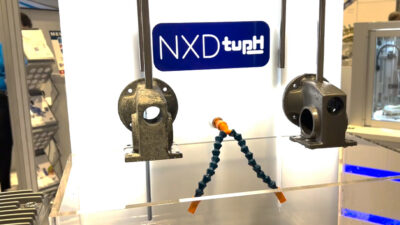
One of those devices is a proprietary safety shroud mounted on the RC20’s end-of-arm tooling. FlexLink 3D prints the shroud and secures it with four or six rare-earth magnets, designing it to detach at 65 newtons or less.
Shaw said the threshold is based on the masticatory muscle impact limit outlined in ISO/TS 15066, rather than a general upper-body impact limit. The standard does not permit impacts to the head or face. However, FlexLink designed the shroud to provide protection against potential contact in those areas if someone enters the palletizing cell during operation.
“Our view is to design the shroud to have this detachment force, as we cannot stop somebody bending down and their head being lower for example,” he said.
Two dual-channel safety proximity sensors monitor the shroud, helping prevent the safety function from being bypassed. If contact causes the shroud to detach, the system stops, allowing the operator to restore the protective device before resuming production.
“It’s a simple reattach the shroud and press reset, and you continue mid-cycle. You don’t need to change any parameters. You don’t need to put in the box number again. It will continue mid-cycle,” said Shaw.
FlexLink also incorporates active safety padding around the robot’s wrist and elbow joints.
“They’re soft foam pads, but they’re also active. There’s a number of safety switches inside and they’re all in series on the same safety circuit,” said Shaw. “So, you hit any one of those, the shroud, the paddings, or anything like that, it’s all on the same safety circuit. It’s a contact stop and a simple reset to continue.”
The combination allows FlexLink to address potential contact at different points on the robotic arm while keeping the palletizing cell accessible to nearby operators.
Extending safety beyond individual machines
Shaw said Coesia designs its broader packaging equipment portfolio with interlocks and coordinated safety controls, whether a manufacturer purchases an individual machine or an integrated production line.
“I’d say for the broader portfolio across all Coesia companies, safety is probably paramount across all of our systems. We offer every device, system, or cell is completely interlocked,” he said.
Coesia also coordinates the operation of integrated production lines, including communication between machines and line-wide safety functions. The companies use common hardware and communication protocols to support global safety controls and localized emergency stops, allowing individual machines and sections to operate within isolated safety zones while remaining connected.
“They’re all designed to talk to each other. They’re all designed to interact,” said Shaw. “You can have isolated safety zones, but everything is designed to seamlessly interact and integrate together.”