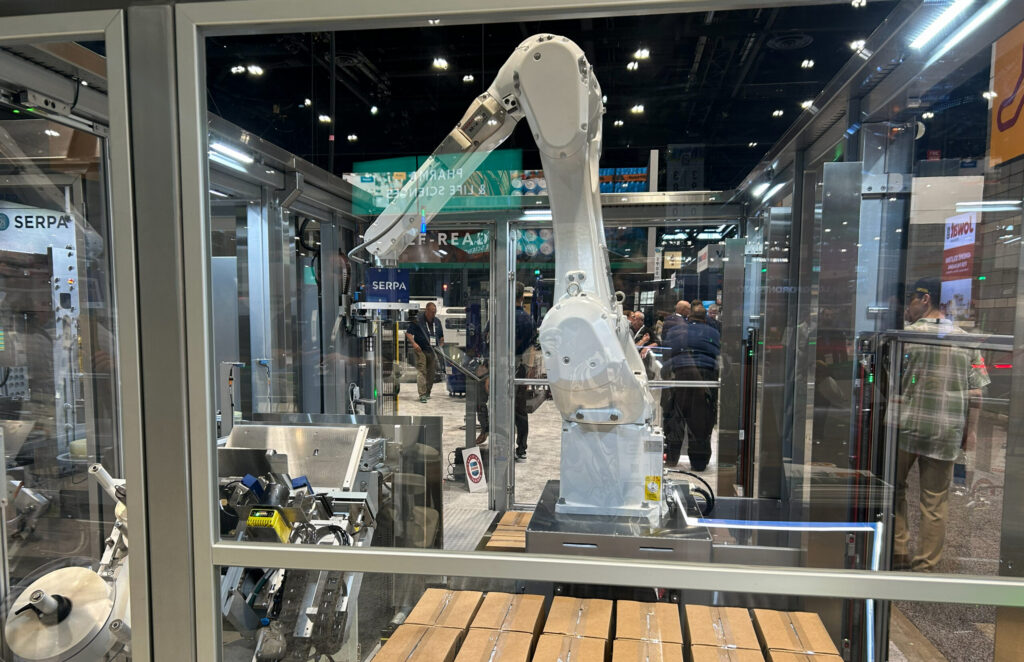
Serpa Packaging Solutions, part of ProMach, introduced a new integrated case packer and robotic palletizer at PACK EXPO International 2026 in Chicago. The system reduces the equipment footprint by approximately 40% compared with installing the company’s two machines separately.
The combined unit brings Serpa’s side-load case packer and dual-cell robotic palletizer into a single frame, eliminating much of the intermediate conveyance traditionally required between the two operations. The integration also brings case labeling and rejection functions into the palletizing unit.
Packaging OEM spoke with Caden Johnston, vice president of sales at Serpa, about the machine’s design and the customer needs that influenced its development.
“The main driver for this specific application was that a lot of our customers are trying to maximize the footprint that they have in existing manufacturing facilities,” said Johnston. “So, it’s taking current solutions that we have and leveraging them to those end users to have a case packing and palletizing solution in more of a compact footprint.”
Reducing floor space without sacrificing access
Johnston explained that a conventional case packing and palletizing installation may require three to five feet of conveyor between machines to accommodate labeling and case rejection. To reduce that distance, Serpa incorporated the label applicator into the palletizing unit and positioned a reject bin beneath the robotic palletizer.
“We reduced our footprint by 40% overall, and it’s a modular design,” said Johnston.
Achieving that reduction also meant preserving access for operators and maintenance personnel.
“We say we have the best access in the industry for operators and maintenance. It’s tough to be the most compact footprint and also the most accessible,” said Johnston.
He explained that reducing the machine’s footprint doesn’t necessarily mean making its components harder to reach.
“People think compact stuff is crammed on top of each other, but we’ve been able to design equipment across all of our portfolios, whether it’s cartoning or case packing, to be compact in footprint but still leverage the same accessibility,” said Johnston.
Building flexibility into changeovers
Beyond floor space, Johnston said manufacturers are considering how their equipment investments will accommodate future production needs.
“Flexibility, by far flexibility. I find with most of our customers that we deal with they are doing ROI calculations and making investments, and those investments they want to be able to not only run multiple sizes currently, but they want future capabilities to be built in,” said Johnston. “And that is something that we do well by just design.”
Serpa says the integrated system supports changeovers in less than five minutes. Its base machine features tool-free adjustments, while a changeover verification system provides operators with feedback as they reposition components for different product sizes.
The system uses absolute position indicators on rotary adjustment dials, with Beckhoff Automation displays positioned near individual changeover points. The machine’s primary controls use Allen-Bradley technology from Rockwell Automation.
Johnston explained how the localized displays communicate with operators when they select a new SKU or recipe on the main human-machine interface (HMI).
“It triggers a message through all the individual change points,” he said. “The screen says ‘Hey operator, we’re running a new size. A changeover is incomplete.’”
Operators receive live position feedback, with red and green indicators showing whether adjustments are complete. The displays also provide visual references for the required setup.
Once the adjustments are verified, the system communicates their completion to the main HMI, allowing the operator to proceed with production.

Improving case handling and jam recovery
Johnston said Serpa’s case packer incorporates features intended to address common problems with corrugated case handling and product loading.
“Your two main areas of failure in a case packer are in your pick of the magazine, the case blank out of the magazine, and in your loading of the product into that case,” he said.
To address those challenges, Serpa incorporated dual-sided vacuum case erecting and an overhead slide guide designed to accommodate variations in corrugated materials and reduce case mispicks.
A telescoping loading funnel extends into the erected case and follows the product during loading, helping prevent it from catching on the exposed edges of the corrugated flaps.
For cases that become jammed during closing, Johnston said Serpa’s Easy Case Clear-Out design allows operators to release and slide out the closing section to remove cases or products without tools.
The system is also serialization-ready for pharmaceutical, medical devices, and nutraceutical applications that require product tracking and aggregation. Serpa says it can also be used in other consumer packaged goods applications, depending on production speeds and packaging requirements.