Packaging may be one step in a product’s journey, but it’s not the last. After leaving the machine, the product may still need to be inspected, labeled, weighed, rotated, palletized, and moved toward storage or shipping.
Increasingly, those steps are being connected through automation, reducing the manual handoffs that once separated packaging from warehouse operations.
It’s a shift that was on display in Chicago at Automate 2026, where companies including Direct Conveyors, Coesia’s AMC Automation, Rockwell Automation, and The Raymond Corporation highlighted technologies designed to keep both products and information flowing across operations.
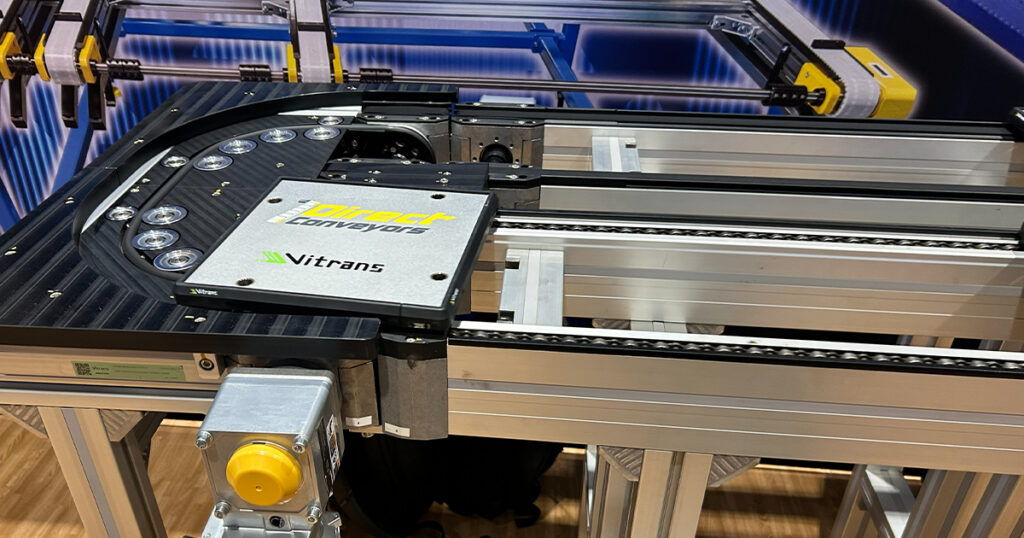
It also means the role of the conveyor itself is changing. Tyler Wood, vice president and co-owner at Direct Conveyors, said it’s no longer simply about moving a package from one point to another. Conveyors are increasingly being used to position, rotate, and manipulate packages for inspection, labeling, robotics, and other downstream processes.

Subscribe to the Packaging OEM newsletter
Get the latest news, trends, and technology updates delivered straight to your inbox and make smarter packaging decisions.
“What we’re getting really challenged with is, I need to be able to manipulate that package. I’ve got to flip it, rotate it. I need to get to the bottom of it because the label or labels are on the bottom of this package,” said Wood. “We’re starting to see a lot more manipulation requirements of packages.”
The change extends beyond conveyors. Vision systems are taking on inspections once performed manually, warehouse automation is moving products deeper into facilities, and orchestration software is connecting individual systems around production demand.

Preparing products for downstream automation
As conveyors take on more of the process, they also need to prepare packages for the automation that comes next.
Wood shared that Direct Conveyors has observed more demand for systems that accommodate increasingly complex pallet patterns. “What we’re seeing a lot more of is being able to give the robot the box and the orientation it needs, so it can pick and set it on the skid the way it needs to be set,” he said.
RESEARCH | Smart Conveyors: Redefining Material Handling and Packaging Line Performance
Rather than requiring the robot to orient every individual case, conveyors can prepare groups of boxes in the pattern needed for each section of the pallet. Wood said those applications are increasingly coming directly off packaging lines before cases continue into logistics operations.
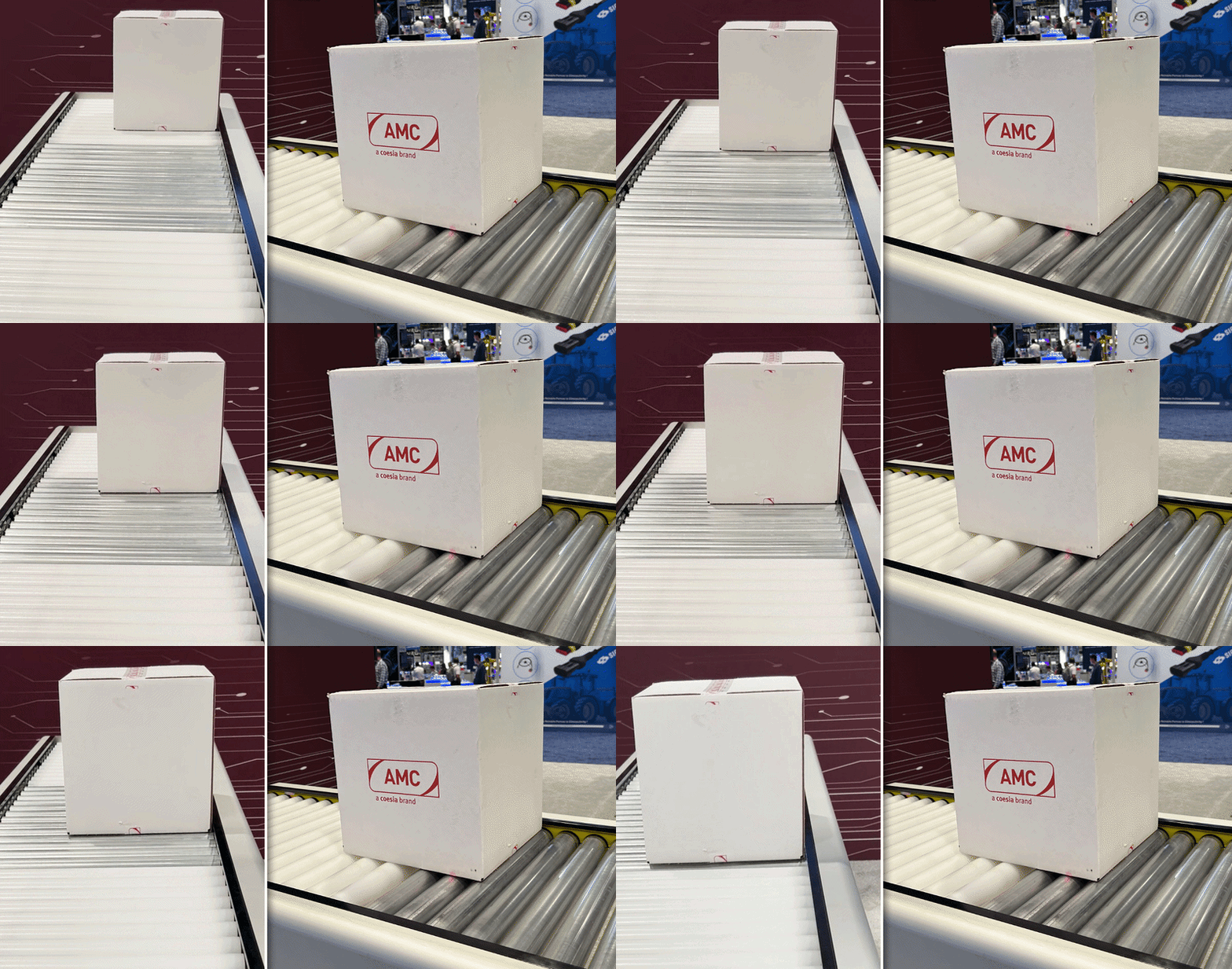
That need to handle individual units is also shaping conveyor design. AMC Automation, part of Coesia, introduced its next-generation Zero-Pressure Accumulation (ZPA) Conveyor System. It’s designed to move and accumulate products without contact between packages.
“What we see more and more, especially with e-commerce and packaging, is single-piece flow, where parts are different from one to another,” said Xavier Le Gros, general manager at AMC Automation. “Zero pressure permits the system to actually handle all on a single-piece flow and less damage.”
Le Gros said controlling individual packages can reduce damage while making it easier to identify and route items to the correct destination.
Vision systems reduce manual checks
Transporting items between packaging and logistics also requires checks that were traditionally handled by operators.
Wood explained that advances in vision systems are helping to automate steps such as verifying items, reading labels, inspecting packages, and confirming cases are ready to continue downstream.
“The biggest automation in that world that has really advanced is less about the robotics and the conveyors. It’s more about the vision systems,” said Wood.
He said machine vision has become more accessible and reliable compared with a decade ago, allowing inspections to take place while packages continue moving through the operation.
“It’s done. It’s in the package. Let’s label it. Let’s weigh it. Let’s vision-inspect it. Let’s make sure the lids are shut; it’s taped,” said Wood. “That’s all usually done on a lot of conveyor systems, and then it’s straight out to the logistics side.”
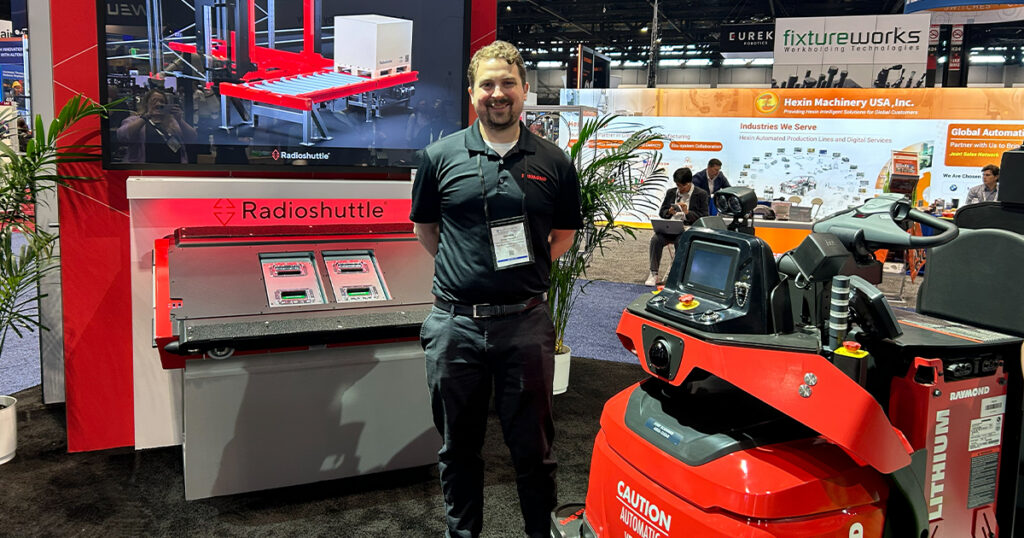
That push to reduce manual handoffs continues inside the warehouse. Raymond, part of Toyota Material Handling, uses automation across vehicles, storage systems, perception technology, and software.
Shawn Donahue, product marketing manager for automation at The Raymond Corporation, said individual automated systems lose some of their value when workers are still needed to connect one process to another.
“If you have an automated system that requires people at either end to be the integrator or be the go-between, well, you’re not really realizing the full value of that automation,” said Donahue. “Having that fully integrated system allows them to get the most value out of their automated systems.”
Automation extends into the warehouse
Raymond connects material movement with storage systems as products move deeper into warehouse operations.
In Chicago, the company showcased its automated swing-reach truck for full-pallet movement in very narrow aisles. The system can operate both inside and outside the aisle, using wire guidance in the aisle and LiDAR-based navigation outside it.
RELATED | Living on the edge: Bringing AI closer to material handling operations
Raymond also demonstrated its enhanced perception technology, which uses cameras to identify people, payloads, and pallet pockets. Donahue said the technology allows the automated truck to identify those objects and make small adjustments as it approaches and handles a pallet.
For situations the automated vehicle cannot resolve on its own, a remote operator can take control and address the problem. An artificial intelligence-driven algorithm can learn from those interactions and reduce the need for intervention when similar situations occur again.
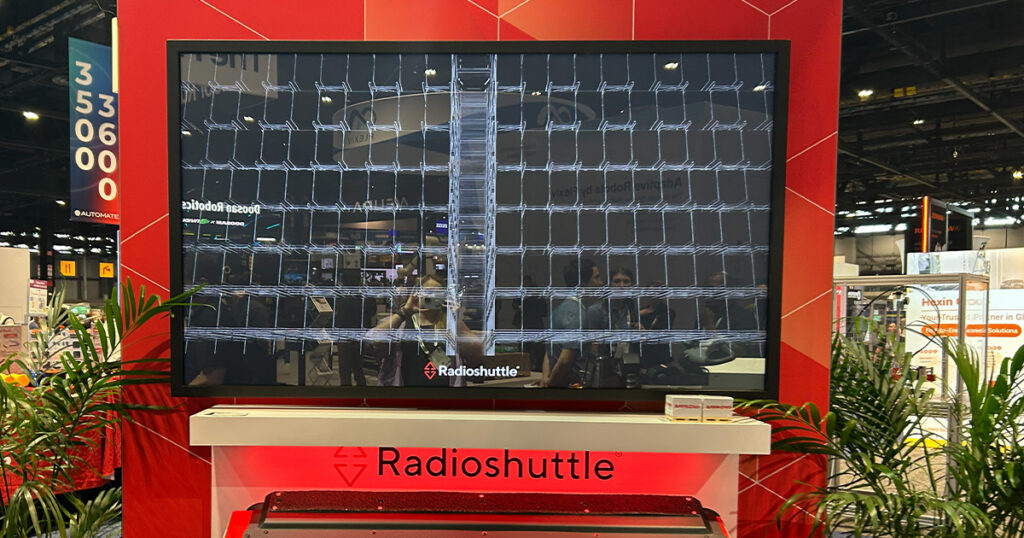
Raymond is also using automation to make better use of warehouse space. Its Radio Shuttle system moves pallets within high-density storage lanes, while Radio Shuttle Duo adds horizontal movement between lanes. Combined with an elevator, the system can operate across multiple levels of storage.
MORE COVERAGE | Toyota Material Handling North America opens new forklift factory
As warehouses become more automated, Donahue said customers are looking for ways to respond to changing operational demands.
“I see adoption continuing to gain steam in the next five years,” he said. “A huge reason that I say that is our customers are having the demand from their own customers for higher throughput, more consistency, being able to deal with seasonal changes, and being able to adapt their operations.”
Connecting the ‘islands of automation’
As more warehouse processes become automated, manufacturers need a way to coordinate when and where material moves.
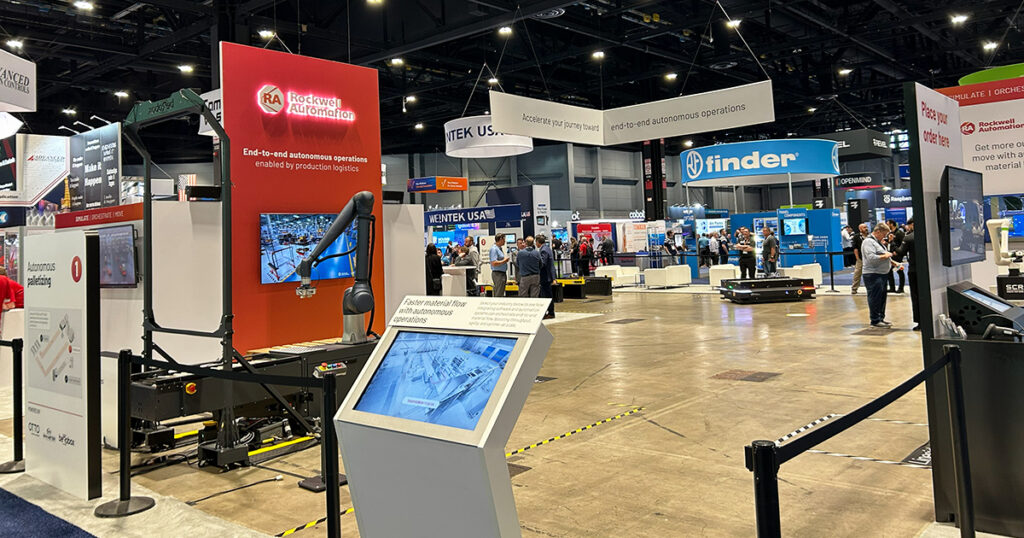
To help connect automation technologies with plant IT and operational technology systems, Rockwell Automation introduced FactoryTalk Orchestration. The platform is designed to coordinate material movement based on production demand.
Ara Surenian, business manager for production logistics at Rockwell Automation, said that manufacturers can add new technologies and still end up with “islands of automation,” where individual systems perform their intended tasks but remain disconnected from the larger operation.
“When we talk about end-to-end, we’re really thinking about from order creation through delivery, and all the steps in between,” said Surenian. “From managing the inventory, deploying the inventory to the production line, moving it through, and then from there going to the warehouse and out the door.”
PODCAST | The Robot Report Podcast: Editors recap physical AI, edge computing, and robotics at Automate
FactoryTalk Orchestration was developed after Rockwell added OTTO Motors’ autonomous mobile robots (AMRs) to its portfolio. Surenian said integrating AMRs into a manufacturer’s broader IT and OT systems could require a costly, custom process, creating a need for software that could integrate those technologies with the rest of the operation.
“Rockwell Automation is that company that provides the hardware and the software to move that digital transformation forward,” said Surenian. “Adding something like an AMR to our portfolio added another piece to that overall puzzle. Now we can help our customers get to that mission of autonomous operations much closer than they were before.”
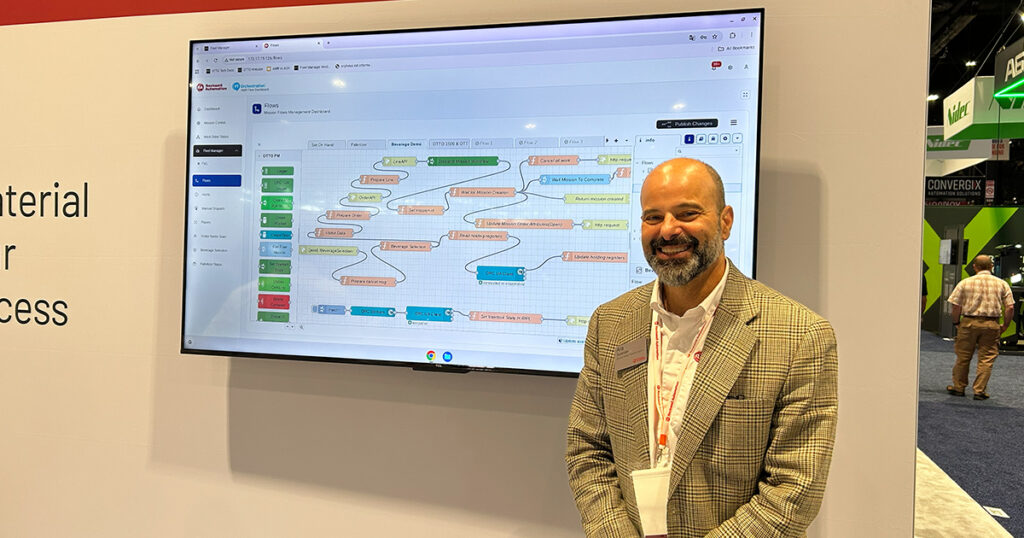
Rockwell first deployed the software within its own manufacturing operations at its facility in Twinsburg, Ohio. AMRs replaced workers manually pushing carts to production lines. But the process still relied on people to signal when material was needed and tell the AMRs when to move it.
By connecting those material movements to production demand, the system can adjust as schedules change and deliver material when it is needed.
“Now everything is in sync with the actual production demand,” said Surenian. “That’s where the value is created.”
Rockwell reported about a 50% reduction in work-in-process inventory and a 20% improvement in throughput at the Twinsburg facility. Surenian said space previously used to stage carts and inventory could also be used for additional production.
Keeping products moving
Connecting packaging and warehouse automation does not eliminate the need to manage what happens between each step.
Wood said conveyors still provide staging and queue space between robots, AMRs, and other equipment. That buffer helps keep one process from waiting on another and potentially slowing everything upstream.
“You always need to connect processes, and that’s where we live,” said Wood.
The conveyor is only one piece of the product journey. Maintaining product flow increasingly depends on how well packaging, material handling, warehouse automation, and software work together.