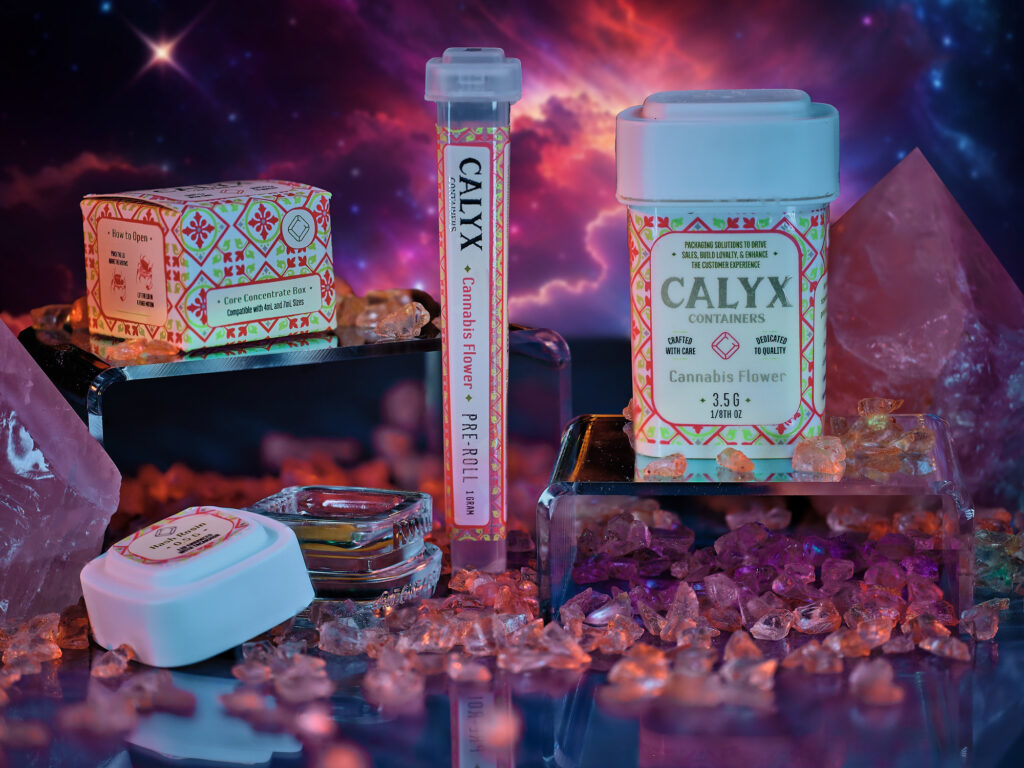
At Calyx Containers’ Salt Lake City operation, cannabis packaging can take several forms before it ever reaches a dispensary shelf.
Inside the company’s 17,000-square-foot facility, a rigid child-resistant container may be molded while flexible packaging moves through digital printing, laser die cutting, and pouch converting. Meanwhile, other types of bags are being designed to hold pounds of cannabis flower through its curing process.
The formats may be different, but they share the same challenge: cannabis packaging needs to protect a sensitive product while meeting regulations, standing out to consumers, controlling costs, and running efficiently on packaging equipment.
Alex Gonzalez, president and co-founder of Calyx Containers, describes packaging as the piece that brings those competing priorities together, including cost of goods sold (COGS).
“It’s like this puzzle where it needs to meet the COGS target, the budget requirements, and it needs to work in the production line for efficiency purposes. It needs to meet marketing expectations and preserve the product inside,” said Gonzalez. “It’s like this central puzzle piece that needs to fit so many edge pieces.”
For the past decade, Calyx has worked across those demands, expanding from its original square child-resistant container into rigid and flexible packaging, labels, preservation technology, and formats designed to run at scale.
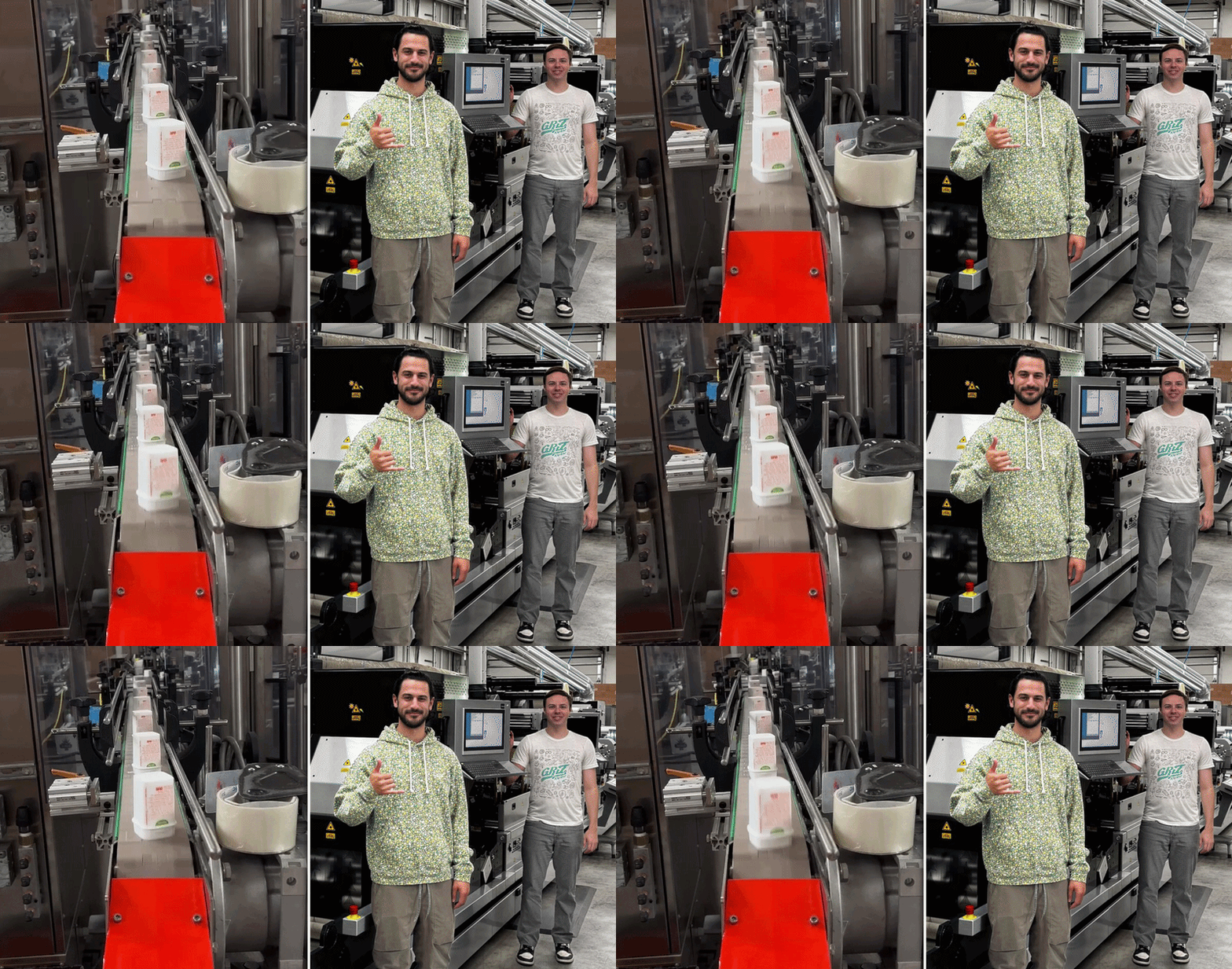
Rethinking the cannabis container
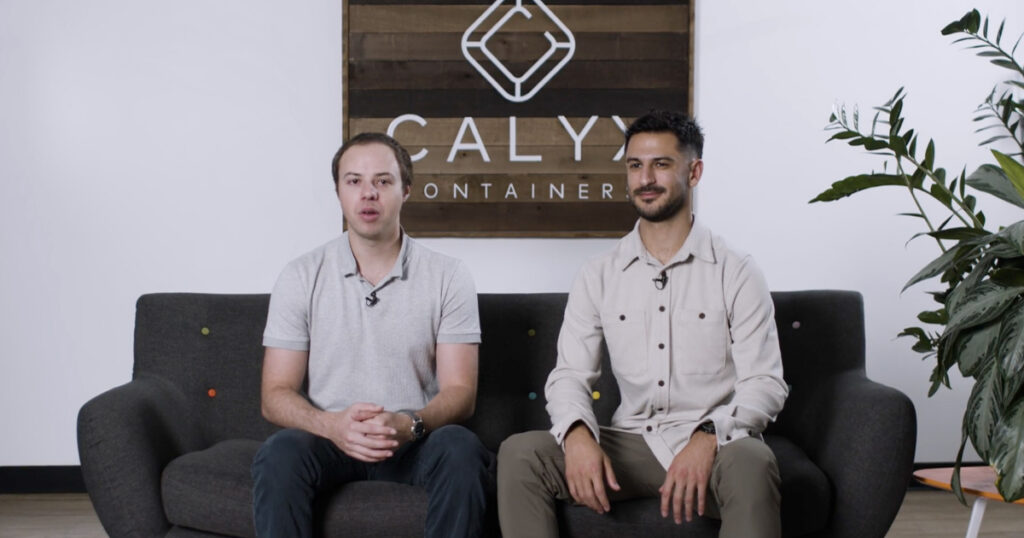
Calyx Containers’ origin story dates to 2016, when Alex Gonzalez and Simon Knobel were roommates at Babson College in Massachusetts. The two said they were looking for a way into the growing cannabis industry.
They found their opening in packaging.
The pair looked at the familiar round, orange prescription-style pill bottle commonly used for cannabis and wondered if there was a better option.
“We saw that it was invented in the 1960s and we thought there must be a better design for this. We created the first ever square child-resistant container, the Calyx Container,” said Knobel, CEO and co-founder of Calyx.
The container was designed to be aesthetically pleasing while improving freshness.
Calyx also changed the way the package seals. While traditional closures often use a circular foam liner, the company developed a multi-shot gasket that places thermoplastic elastomer material around the inside edge of the square lid.
“Most people don’t know that you only need a little bit of material edge for sealing purposes. So, it actually is a pretty wasteful process to put a traditional liner in a cap,” Knobel explained. “We shoot a thermoplastic elastomer (TPE) material in around the inside of the square lid and provide a better seal while using up to 95% less material.”
The company later carried its square and rectangular approach into other formats, including a square-neck glass container for cannabis concentrates.
Following the preservation problem upstream
For its first seven years in business, Calyx focused on what Knobel calls point-of-sale packaging. Then the company looked upstream and found cannabis quality could already be declining before it entered the final package.
“We realized that a lot of the quality degradation was actually happening during the process called curing. That’s the stage after you harvest and dry cannabis,” said Knobel. “It’s kind of like a wine or a whiskey, where you’ll do that aging process and that’s where a lot of the flavor profiles mature.”
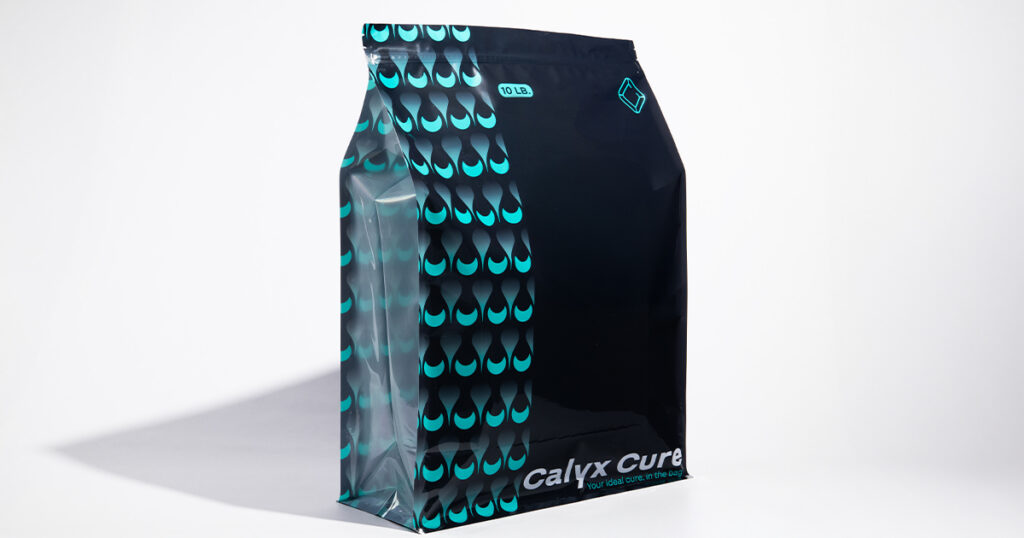
That shift pushed Calyx into bulk cannabis packaging. About two years ago, the company developed a new product line called Calyx Cure.
“It’s a nine-layer passive, modified atmospheric, breathable film that actually helps with terpene and product preservation upstream in the supply chain,” said Knobel.
The film is used in flat-bottom pouches that can hold between one and 10 pounds of cannabis. It’s engineered to allow moisture and oxygen to permeate through the material, creating what Knobel described as an optimal microclimate inside the pouch.
“We’re seeing around a 13% improvement in terpene preservation for the cannabis flower [from traditional curing methods]. Once you go into the harvest and dry phase, it’s all about retention,” said Knobel. “You’re not going to increase potency or terpenes, but it’s kind of a maintain it or lose it type of environment. And once it’s lost, it never comes back.”
Bringing packaging ideas to life faster
As Calyx broadened its packaging portfolio, the company wanted to speed up the design, testing, and refinement of new concepts.
The company started in Massachusetts and initially worked with a contract manufacturer in Salt Lake City. As Calyx moved into labels and flexible packaging, Gonzalez and Knobel decided to build their own facility next to the injection molding operation.
“We made the decision on a Thursday, and we flew out to Utah on a Saturday. We actually ended up putting a deposit down on a building that next Monday and started to reach out to equipment manufacturers to start planning out our new facility,” said Knobel.
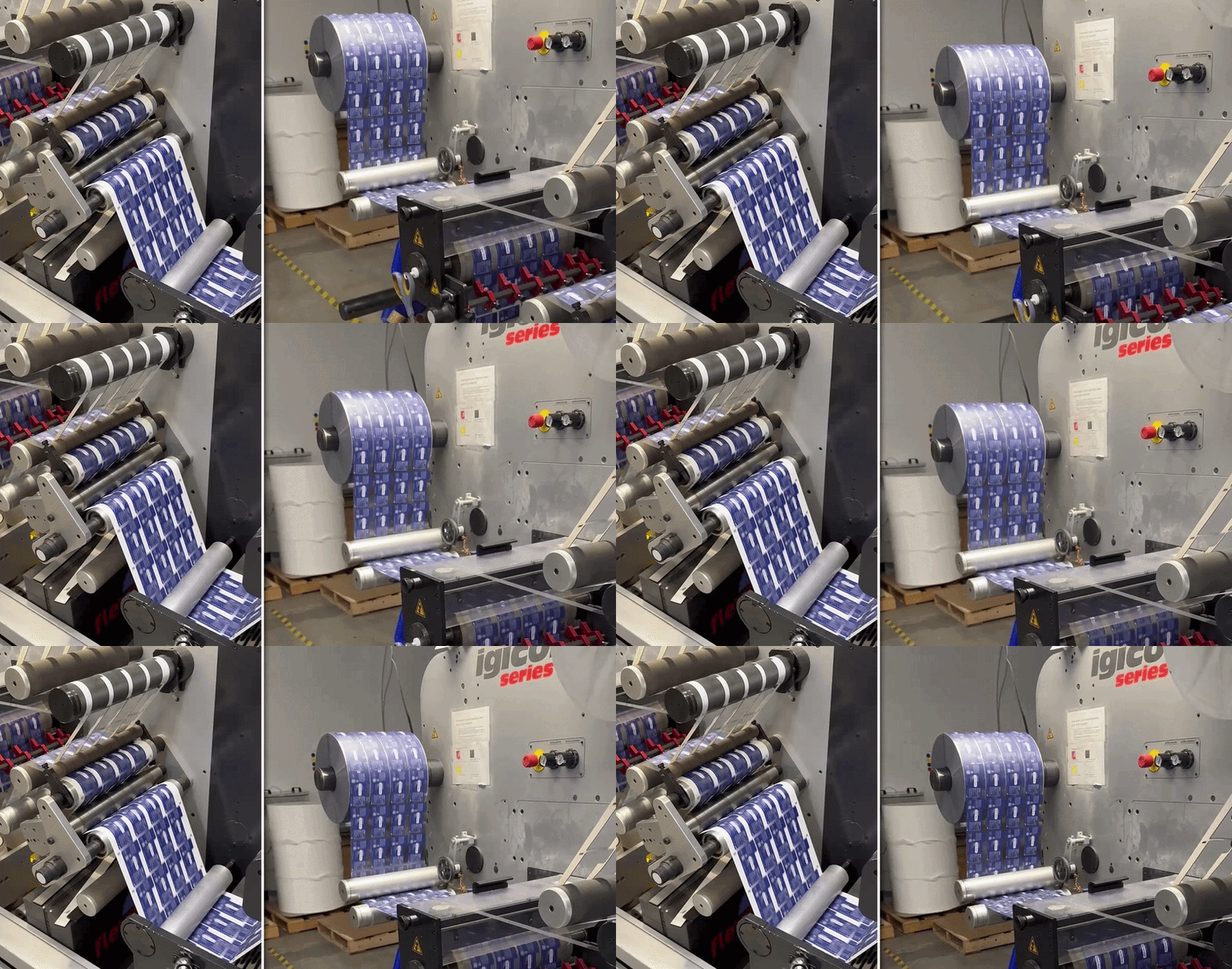
The 17,000-square-foot operation focuses on labels and flexible packaging primarily through digital printing and embellishments, laser die cutting, and pouch converting. It also serves as Calyx’s innovation hub.
Knobel said working through third-party manufacturers on the iteration process could take four to six weeks. Calyx set out to cut that to four to six days.
The company uses computer-aided design (CAD) software, including Autodesk’s Fusion 360, to develop packaging. It also uses 3D visualization to help customers see what a package will look like before moving to a physical sample.
“That’s an area that we’ve really been focused on. How do we create more interactive visualizations for our customers, so that they can get closer from that flat 2D layout to 3D and then obviously we’ll produce physical samples when needed,” said Knobel.
For some customers, development moves directly onto the production floor during what Gonzalez calls “print and play” days. Calyx reserves production time so teams can test a package, review the result, make changes, and send the revised version back to press.
“We’ll secure a few hours of production where the team comes in, and we’re testing something right on the line with pouching or label printing. A certain kind of embellishment will print a different way to represent that color spectrum right then and there,” said Gonzalez. “We show them the sample, refine the file, send it right back to the press, and just iterate, and get it knocked out in a few hours versus what honestly can take months overseas.”
That faster development cycle also gives Calyx a chance to determine whether a concept can move beyond a prototype and into repeatable production.

Subscribe to the Packaging OEM newsletter
Get the latest news, trends, and technology updates delivered straight to your inbox and make smarter packaging decisions.
Making a new pouch format work at scale
Manufacturability is also part of Calyx’s work with Sun Centre USA, an OEM known for flexible packaging machinery and the Cuboid box-shaped flexible package format.
Calyx had already built its rigid packaging around square and rectangular shapes and wanted to explore how a similar format could work in flexible packaging. The challenge was not simply achieving the shape. It was determining how the format could be produced efficiently at higher volumes.
“It’s one thing to make something pretty that you can make one part per minute and cost $3, but to make something truly designed for manufacturability is a whole other process,” said Gonzalez.
Calyx uses a Sun Centre system with capabilities including multi-web processing and die cutting, allowing the company to test different structures and materials. The Cuboid format separates the closure from the product compartment, allowing the pouch to be filled more completely while reducing excess headspace.
Calyx also developed a thinner child-resistant zipper for use on Sun Centre’s equipment. Knobel said the design is easier to crush during production, resulting in a 10% to 15% increase in run speed, which has helped Calyx mitigate rising raw material costs being passed on to its customers.
Validating packaging on OEM equipment
Calyx has carried that machinery-and-material approach into its work with packaging OEMs supplying equipment to cannabis producers.
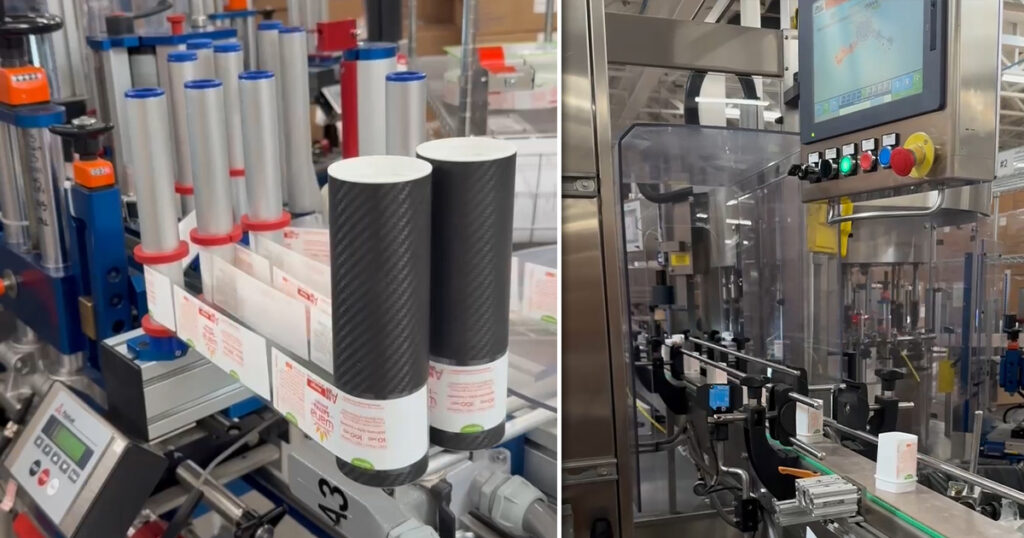
Gonzalez said the company has worked with builders of weighing, filling, capping, labeling, and other systems to help ensure Calyx packaging runs on their equipment. The work is partly about total cost of ownership. Gonzales said package price alone does not determine the true cost if the material creates scrap or production downtime.
“It’s one thing to get a cheap package from China that runs well,” said Gonzalez. “It’s a very different thing to get a cheap package that ends up with two weeks of production downtime.”
Calyx can also provide smaller packaging runs for factory acceptance testing. Knobel said OEMs sometimes have machinery ready to test but are still waiting for packaging samples from the customer.
“The machine will be ready, and then the customer says, oh, it’s going to be another four weeks until we get those samples,” said Knobel. “That holds up the whole deployment process. We work hand in hand with these equipment providers.”
Providing those samples earlier allows the OEM to test the package before the equipment ships and gives customers more confidence in expected production rates and scrap levels.
“We’re working towards providing more of these validated packages, so they have that confidence that their ROI model is actually going to become achievable once they get to the implementation phase,” said Knobel.
When state laws change the package
Cannabis packaging requirements vary by state, and those differences can involve labeling, child-resistant mechanisms, colors, testing procedures, and materials.
For brands operating in several markets, that can mean multiple versions of the same package.
“In Florida, you can only have a black and white package with one color on it,” said Knobel. “You need to now work with potentially one brand that actually has to have 13 different types of packages if they’re in 13 different states.”
Those regulations add another layer to Calyx’s packaging design and production process, alongside product protection and machine performance.
Beyond the cannabis container
Knobel and Gonzalez see cannabis packaging moving toward more measurable approaches to product preservation, with growing interest in testing which formats best preserve flower and concentrates.
“There’s still a whole area to explore around how to actually preserve cannabis, whether it be active modified atmospheric solutions or passive solutions?” said Knobel.
At the same time, package formats continue to shift. Gonzalez said price pressure pushed many cannabis brands toward lower-cost flexible pouches, including Mylar formats, but some operators are beginning to reconsider rigid and custom formats as a way to differentiate their products.
“When you go into a store dispensary, it’s a wall of pouches,” said Knobel. “Now that there’s a little bit more stability in the market, some brands are focused on being thought leaders and are coming back and saying, you know what, what if we did stand out.”
Longer term, Gonzalez expects cannabis packaging to develop more standardized performance testing, including measures such as oxygen transmission rate (OTR) and moisture vapor transmission rate (MVTR).
“My long-term bet is cannabis packaging is going to get standardized down the road, if not in format or function, in terms of design,” said Gonzalez. “I think there’s going to be a preservation standard with cannabis packaging and we want to be on the forefront of that discussion.”