At Wyandot Snacks in Marion, Ohio, robotics didn’t replace employees – it helped add 100 of them.
By partnering with Formic and its robotics-as-a-service model to deploy automation at the end of the packaging line, the snack manufacturer increased throughput and stabilized operations in a rural community where finding skilled labor can be a challenge.
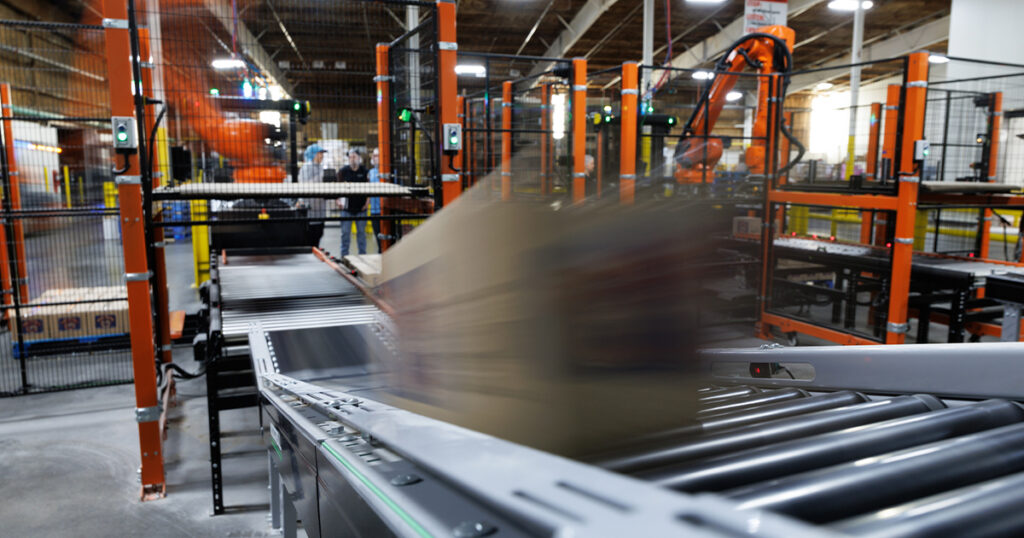
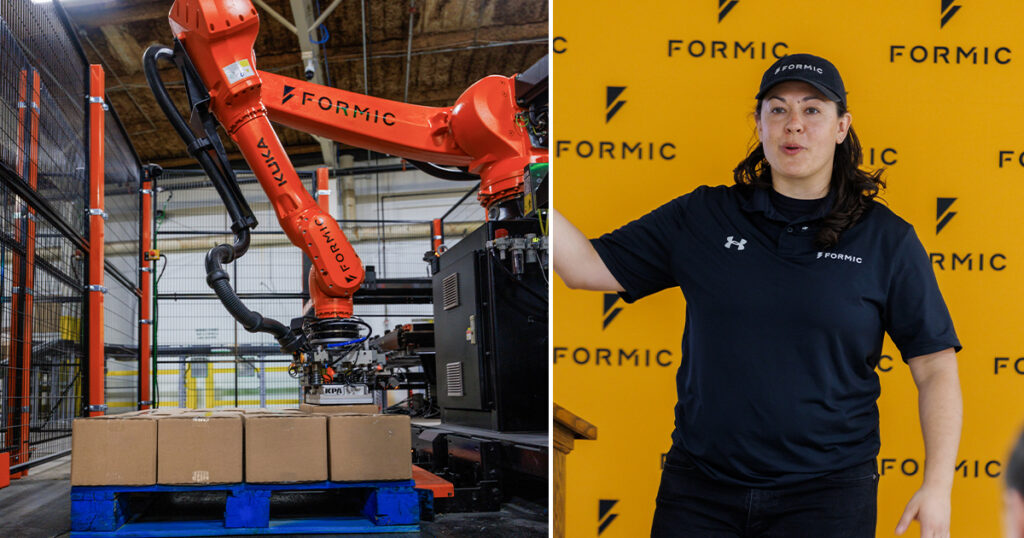
Those systems were integrated into a nearly century-old facility that was never designed for today’s production demands. Packaging OEM visited the site, where robotic palletizing cells now handle cases of cereal and tortilla chips.
The work is happening at a facility with organized labor, adding another layer to how the technology was introduced and adopted on the floor.
“There was some initial hesitation on the part of employees [asking], ‘Is this going to replace our jobs?’ This is a union shop,” said Jaap Langenberg, CEO of Wyandot Snacks. “Long story short, compared to a year ago, we have 100 more employees than we did in January of last year. We’ve tripled the size of the volume through the plant, and it’s created more jobs.”
Wyandot’s success demonstrates how automation can support scaling rather than simply replace labor. It also reflects a broader shift in manufacturing, where robotics-as-a-service models are being used to enable increased throughput, especially in regions where labor is limited, and operations must scale within existing facilities.
When growth creates pressure
The layout at Wyandot Snacks’ facility reflects nearly a century of manufacturing, with its origins dating back to the Great Depression. At one point, the site produced 25% of the world’s popcorn.
“It’s a 90-year-old company that started in the 1930s essentially as a farming family to sell raw popcorn,” said Langenberg. “The company evolved over the course of years and got into ready-to-eat popcorn and snacks, and Cracker Jacks were made here for decades.”
Today, the plant serves as a contract manufacturer, producing and packaging for national food brands.
As demand from new customers increased, Wyandot needed to quickly scale production from roughly 300,000 pounds of product per week to nearly one million.
“One of the challenges was how we were going to get all that additional product out the door with a limited number of people available?” Langenberg recalled. “And doing so without having a capital budget to go spend millions to do this.”
That incoming demand quickly translated into pressure on the plant floor. Much of the work was still being handled manually, even as volumes increased.
“We were doing everything by hand. It was kind of painful,” said Tucker Bade, director of technical services at Wyandot Snacks.
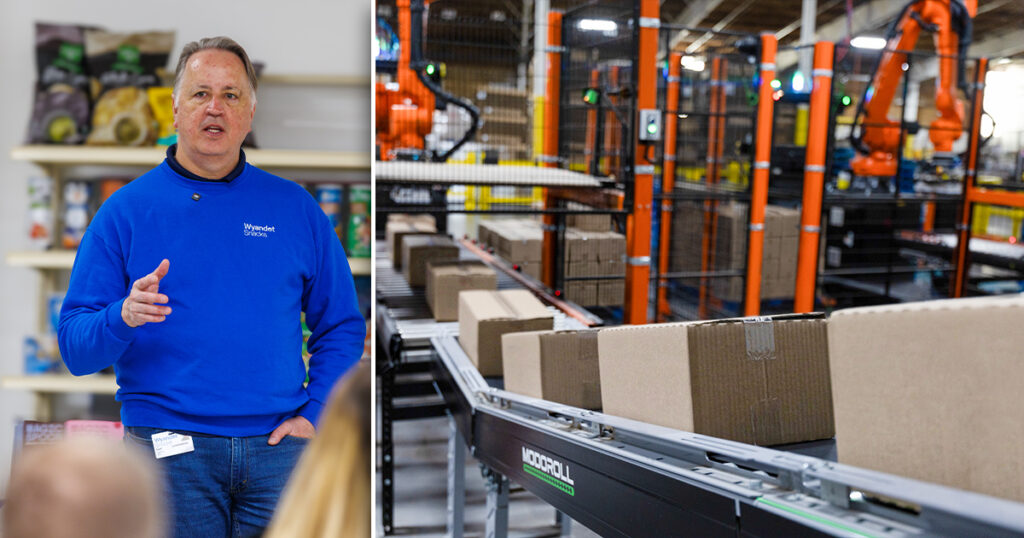
To support that ramp-up in production, Wyandot used automation as a tool rather than a replacement for labor, focusing on reducing repetitive strain while improving consistency and throughput.
It’s an approach that is especially important given where the company is based.
Wyandot operates in Marion, Ohio, about an hour from Columbus. As a smaller market outside the state’s capital, attracting workers is more difficult.
“This is not the most populated area in the world, so getting folks in here is a little bit rough,” said Nick Fulop, senior account executive at Formic.
That labor constraint was a key factor in Wyandot’s decision to work with Formic.
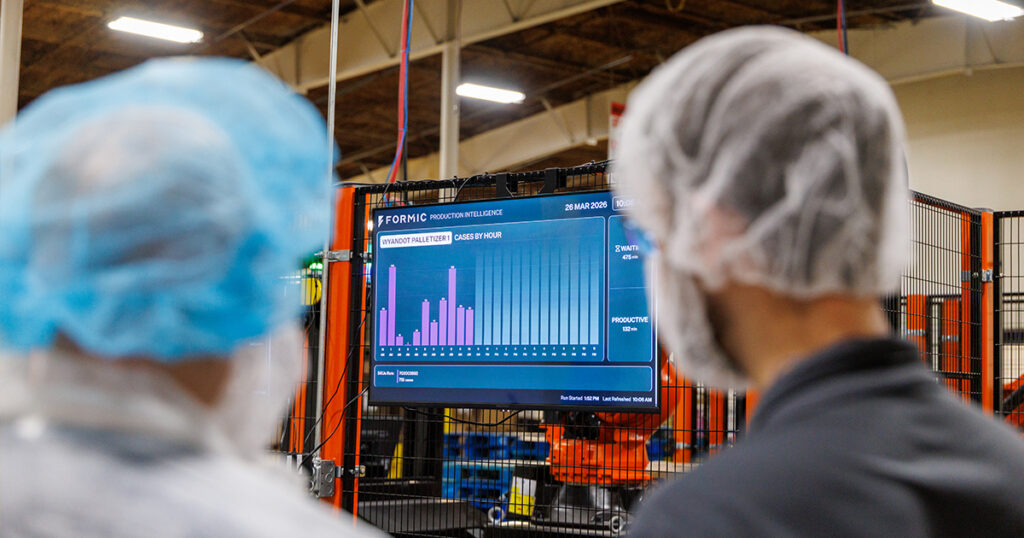
Taking a different approach to automation
While Wyandot had tried to automate its facility before, the approach didn’t stick.
Large upfront capital investments locked the company into rigid systems with long integration timelines. A palletizer and a case packer, for example, ended up sitting unused and collecting dust.
Those installations also required in-house expertise to maintain, and when key personnel left, the knowledge walked out the door with them.
This time was different.
Instead of committing to another major capital investment, Wyandot turned to Formic, using its full-service automation model to integrate robotic palletizing.
The subscription-based model uses fixed monthly pricing with no upfront capital investment, allowing Wyandot to deploy robotic systems and pay once they are running. All while Formic assumes responsibility for performance and uptime.
The partnership also includes 24/7 technical assistance, bilingual service for English and Spanish-speaking operators, and full corrective and preventative maintenance designed to minimize downtime.
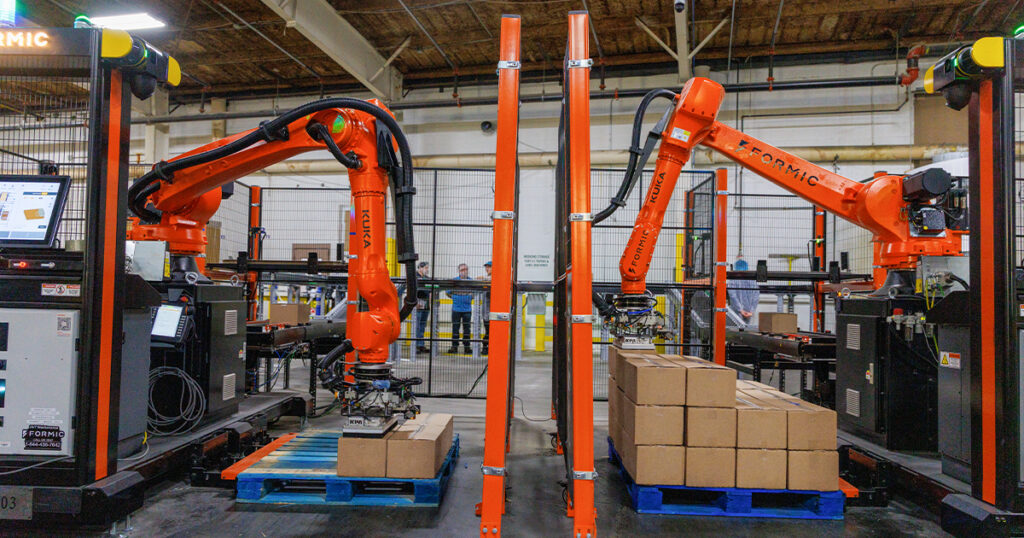
“Formic offered the most cost-effective solution for our team,” said Bade. “They were able to provide everything that we needed from an equipment standpoint.”
That included two robotic palletizing cells, powered by Kuka robot arms, along with the associated conveyors and integration required to move product through the end-of-line.
RESEARCH | Robotics on the Packaging Line: Enabling Faster, More Flexible Operations
The companies implemented a phased approach, focused first on repetitive, physically demanding tasks.
Since deployment, Wyandot has seen output increase threefold, 98% uptime, reduced reliance on temporary labor, and employees reassigned to higher-value tasks.
“With the collators, we’re looking at 55 bags a minute,” said Bade. “Almost doubling the throughput on those machines with the same amount of labor.”
At the plant level, the effect went beyond speed as production volumes increased and the workforce expanded alongside that growth.
“We’ve been able to keep the plant open,” Bade said. “It’s a very depressed area, and being able to create 100 more jobs has made a significant impact on the community.”

When CAD meets real-world facility constraints
While the outcome is clear, getting the systems into a nearly century-old facility was anything but plug-and-play, according to Danielle Vigent, a Formic solutions engineer.
Wyandot integrated robotics, conveyors, and diverts into a tight area of the plant. Products had to pass through a small overhead opening and connect to an existing spiral conveyor at a non-standard angle.
“We had to come off the spiral, which is at a goofy angle, do an S-curve to miss a built-in column, and then come out again at a 37.5-degree angle,” said Vigent. “It was not easy math.”
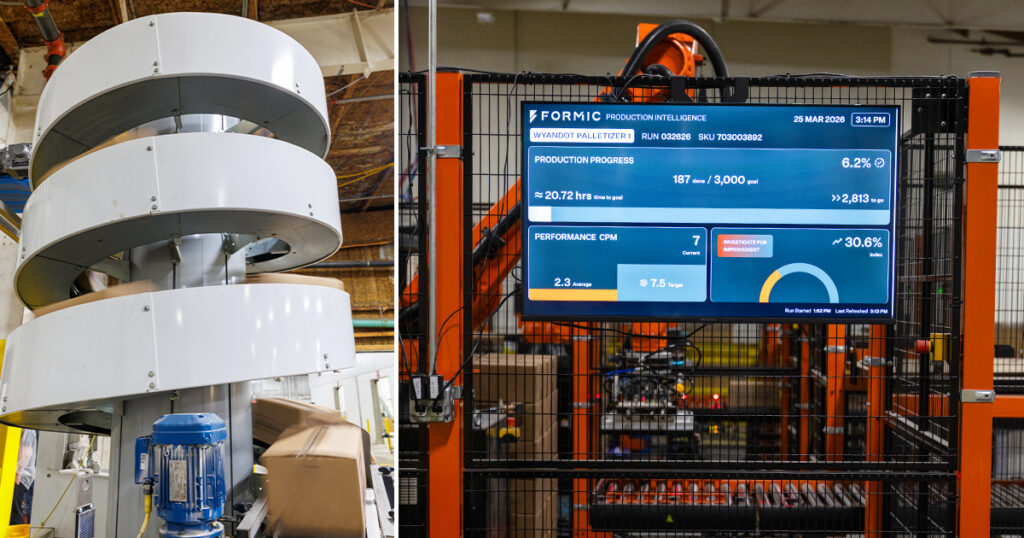
Production intelligence dashboard monitoring robotic palletizing performance, uptime, and throughput at the Wyandot facility (right side of image). Source: Formic
With differences between computer-aided design (CAD) drawings and real-world conditions, paired with upstream equipment that was not yet installed, the team spent a full day on-site working backward from robot placement to set anchor points. They marked chalk lines on the floor to establish precise locations, ultimately defining the layout accuracy on site.
“There was a little discrepancy between the CAD drawings and real life, which happens all the time,” Vigent said. “We had to work back from the robots and make sure that we missed the building column.”
RELATED | Designing the next-generation more sustainable package
Because the line was new, Wyandot had limited product available for testing. Some SKUs were not yet finalized, and in one case, only a single pallet existed, requiring additional on-site programming and later remote adjustments after startup.
Once the line came online, Formic’s service team monitored the machinery from afar, adjusting recipes in real time and making upgrades without full reprogramming cycles.
The result is a high-uptime, flexible installation that shows automation can unlock capacity even in an older, space-constrained facility.
Scaling within physical limits
For Wyandot, automating the end-of-line is just the starting point. With a facility spanning more than 150,000 square feet, there’s only so much physical expansion possible, so increasing output means making better use of the existing space and processes.
“We have to do more with the same amount of space,” said Bade. “The robots are helping us do that.”
From an engineering perspective, the results are clear in practice. “I think it’s all that and a bag of chips,” said Vigent.
As for Wyandot’s leadership team, the impact comes down to execution.
“Having a partner like Formic that handles installation, maintenance, and equipment swapping allows us to stay focused on what we do best: making great snacks,” said Langenberg. “It also reduces the risk and guesswork that can come with large-scale automation projects.”

Subscribe to the Packaging OEM newsletter
Get the latest news, trends, and technology updates delivered straight to your inbox and make smarter packaging decisions.