Each aisle of Pack Expo Las Vegas showcased the packaging industry’s present and future through machinery, materials, components, and artificial intelligence (AI)-powered technology.
With more than 2,300 exhibitors, OEMs, suppliers, and software providers went all in on innovation, demonstrating how automation is making packaging lines faster and easing operators’ day-to-day workloads.
Three clear trends emerged:
- AI is turning production data into actionable decisions
- Flexible systems that let machine builders pivot across materials and SKUs
- Compact hardware that enables quicker setups
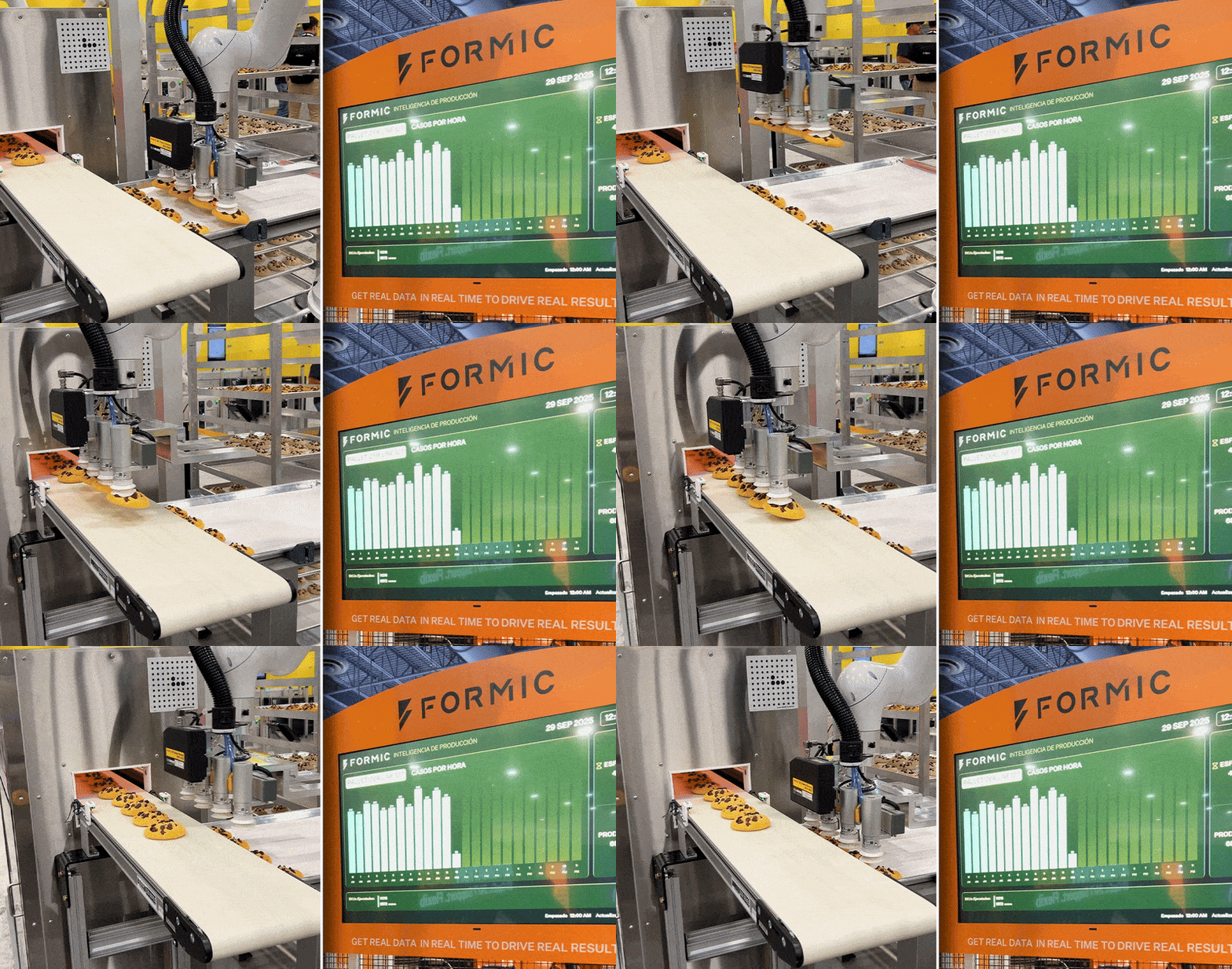
Those ideas moved from concept to reality on the show floor. At Formic’s booth, CEO Saman Farid pointed to a dashboard glowing with live metrics from a Kuka robot depalletizing cell. “This is really the year where AI makes its way into the mainstream,” he said.
Fanuc highlighted a dual-arm collaborative robot (cobot) stacking cookie trays in a steady loop, showing how plug-and-play robotics make automation more accessible. Around the halls, exhibitors featured equipment built for faster changeovers and simpler setups.
Packaging gets intelligent with AI
While AI isn’t new to packaging, the way companies presented it at Pack Expo signaled a clear evolution. Suppliers and integrators are deploying the technology as a practical tool for prediction, maintenance, and decision-making.
John DiPalo, chief strategy officer at Antares Vision Group, described how the Italy-based digitization company connects inspection systems and sensor data directly into packaging and manufacturing networks via tools like AI-GO, a visual inspection platform developed with Oròbix.
“You’re going to see people leveraging the information that they can capture during the packaging process and then layering things like AI and machine learning on top of that,” said DiPalo.

Grantek, a systems integrator that supports manufacturing enterprise systems (MES), sees a similar trend. David McKenna, the company’s practice leader for smart packaging solutions, said that the next step for AI is pairing vision systems with cloud computing so companies can train and deploy models faster.
“The change I’m seeing is the cloud-based systems that make AI build deeper, faster models, very quickly, and then put those onto edge devices on the plant floor,” he said.
RESEARCH: Smarter Packaging Operations With AI
Formic’s Farid, whose company provides robots as a service, pointed to real-time decision-making enabled by AI.
“We see a lot of our customers that once they have access to accurate data, it gives them a lot of confidence to go and win that next bid because they know exactly what it’s going to cost them to produce it, at what rate they’re going to be able to produce it,” he said. “I think data-driven decision-making powered by AI is really critical.”
From cameras and vision systems verifying labels to dashboards forecasting output, AI is becoming part of packaging’s daily workflow, giving machine builders and customers actionable production insights.


Future-proofing packaging lines
Flexibility in packaging goes well beyond formats – it’s become the new baseline for machine design. OEMs are building systems to adapt to run various materials, re-route product flow, and change packaging types – all with limited downtime.
Standing next to an autobagger that can run paper or poly materials, PAC Machinery president Greg Berguig explained that the goal is to give packagers confidence that their equipment will grow alongside the industry.
“Packagers are looking at different types of packaging materials, and they want to future-proof their investment in automation,” he said. “They want machines that are either material agnostic or will allow them to work with whatever’s the next great paper out there, seaweed, or whatnot. They want machines that are extremely flexible.”
The same theme of adaptability extended to product movement, where companies like Kuka are using autonomous mobile robots (AMRs) to automate handoffs between processes. Demonstrations illustrated that flexibility isn’t just about machine motion but about keeping production moving.
As packaging formats adapt, SKUs increase, and order sizes fluctuate, OEMs are building machinery that can keep pace with shifting requirements.

Subscribe to the Packaging OEM newsletter
Get the latest news, trends, and technology updates delivered straight to your inbox and make smarter packaging decisions.
Streamlined solutions for faster ROI
Automation continues to advance while becoming easier to use. Simplicity was a defining theme of the event as companies introduced compact, standardized systems designed for faster integration and shorter ROI timelines.
Fanuc spotlighted plug-and-play robotics stacking cookie trays, designed for quick deployment.
“One of the biggest trends I’ve been seeing is lower-cost, standardized solutions, specifically around the food areas,” said Wes Garrett, executive director of global accounts for food and beverage at Fanuc America. “Something that’s very small in footprint, low-cost, and gets you a very quick ROI.”
PHOTO GALLERY: Pack Expo Las Vegas 2025
JVL A/S, a provider of servo and stepper motors, emphasized modular design.
“You can build around a machine with all the motors, just adding power and communication and not having to think about a control cabinet,” said Kenneth Pilheden, vice president of sales at JVL.
Together, these examples show how packaging equipment is becoming easier to integrate and faster to deploy.

Rolling on innovation: AI, adaptability, and simplicity
From the show floor to the shop floor, the message at Pack Expo Las Vegas was clear: Automation has become more approachable by combining AI, adaptable systems, and streamlined setups for today’s packaging needs.