Inside Combi Packaging Systems’ facility in Canton, Ohio, machines are taking shape across the production floor. But they rarely look the same.
Some machines are integrated with robotics, others are drop packers or case erectors, but one goal remains the same: to design both standard and custom end-of-line equipment tailored to each customer’s needs.
“We have north of 200 different names and models of equipment, everything from a simple semi-automatic case sealer to a million-dollar-plus fully robotic integrated line. We do everything in between,” explained Jason Mitchell, vice president of operations at Combi, during a tour of the shop floor for Packaging OEM.
Most of the work is custom, with machines varying by application. Across more than three dozen assembly bays, employees move between builds, checking in and greeting each other with fist bumps.
In one bay, crews may be designing a case erector that’s destined for production at Carlo’s Bakery, home of the “Cake Boss,” and across the floor, another team assembles a fully integrated robotic system to handle magazines of baseball cards, or even a machine that will soon automate noodle production in Amish Country.
Despite the variety, the machines share a common role: preparing products for shipment, each engineered for its specific function.
“The end-of-line automation market today is unbelievably dynamic. The only constant is change,” said Jeff Guritza, chief growth officer at Combi. “There’s really nothing cookie-cutter about anything that we do.”
That commitment to tailored end-of-line solutions dates back to Combi’s early days.

From bottling roots to packaging innovation
Combi’s Midwestern roots trace back to 1979 when founder Pete Ballas and partner Fred Floyd launched the International Machine and Bottle Orders Exchange, also known as IMBX.
“They started out by buying and reselling Coca-Cola type bottling plants essentially,” said Mitchell. “They bought the mixers, the fillers, the cappers, all the conveyor systems. Then, as a plant would shut down, they would buy it, part it off, and sell it and make some money.”
Over time, the business expanded beyond bottling lines, adding case packing, sealing, and upstream equipment such as baggers and fillers. Around 1984, the company formed a second division, Combi America, and built its first case erectors and drop packers.
“For the next 15 years, we operated as IMBX and Combi America, doing both rebuilt, remanufactured, used equipment, and new equipment,” said Mitchell. “We would combine lines, so a whole line could be built partly new, partly old, but we were doing a lot of upstream equipment as well.”

This hybrid approach continued until 1999, when a joint venture with multinational manufacturer 3M and Italy-based OEM SIAT led to the dissolution of IMBX and the rebranding of Combi America as Combi Packaging Systems.
By 2001, the three-way partnership transitioned to a two-way business with 3M and SIAT. 22 years later, SIAT acquired 3M’s stake, leaving Combi wholly SIAT-owned while continuing to collaborate closely with 3M.
“We still do all the same work we did with 3M. They’re just no longer an owner,” explained Mitchell.
That history of adaptability laid the foundation for the company’s specialization in end-of-line automation.
Focused on the end of the line
Typically, Combi’s equipment sits at the back end of the packaging line, where finished products are packed into cases and prepared for palletizing and shipment. From case erecting to palletizing, the company builds systems that handle multiple functions on the line.
“We do top pick-and-place packing, both electromechanical and robotic. We do horizontal loading and vertical loading. We do drop packing, gravity drop packing, every packing method that there is,” said Mitchell. “We’ve built all the backplane, all the brains to the equipment, and do all the programming for you.”

Many projects also require integration with upstream equipment, making coordination across the line essential.
“Another thing that makes us unique is our ability to handle that level of integration,” explained Mitchell. “Not only from a mechanical integration, but also from the software integration of upstream and downstream equipment.”
RESEARCH | Smart Conveyors: Redefining Material Handling and Packaging Line Performance
Understanding how these systems interact is key when designing equipment that must operate reliably within a broader production line.
“We know what information they need for us to run and what we can or can’t shut down,” said Mitchell.
Custom solutions across industries
This expertise allows Combi to work across industries that often have little in common. Projects range from food processing and consumer packaged goods (CPG) to specialty operations handling items as large as 70-pound truck wheels.
While some systems are built for high-volume production, others may support niche applications. Customization remains central to Combi’s approach to machine design.
“Custom, at least to me, is a very exciting word,” said Alex Untch, senior manager of engineering at Combi. “It’s a way that we can design to solve challenges and requirements for the customer, and we use our decades of knowledge to bring these designs to life.

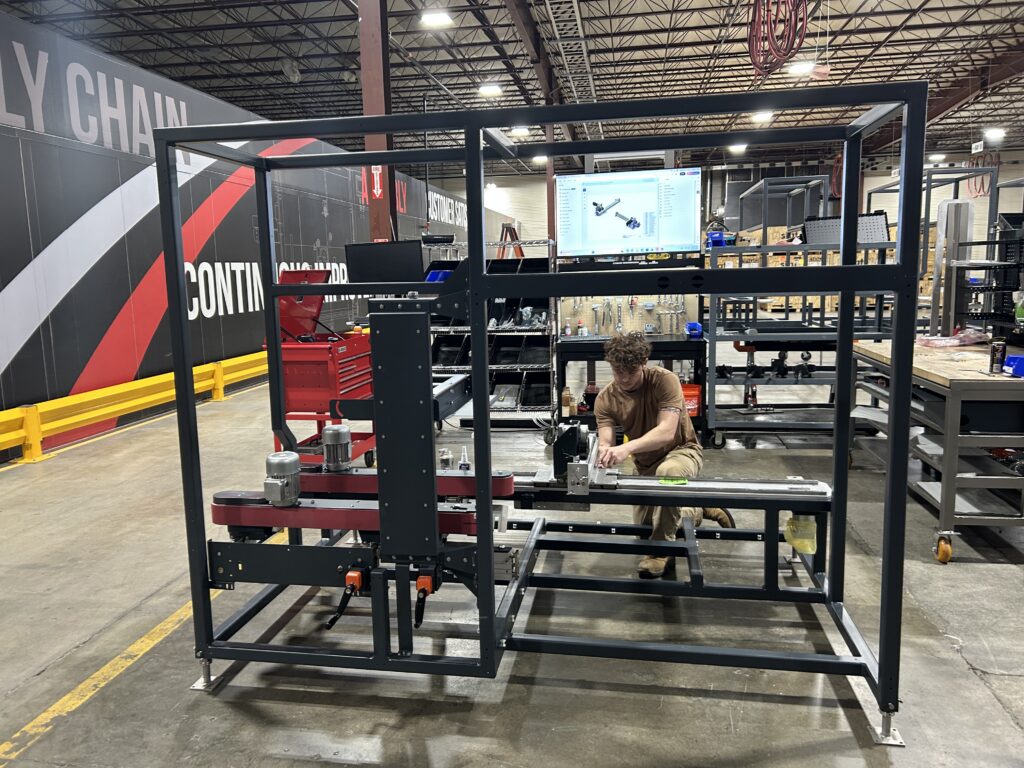
Across Combi’s 41 production bays, no two builds are exactly alike, and the facility is designed to flex with every new project. Multiple machines of varying sizes can be assembled and moved throughout the facility simultaneously, thanks to elevated systems that keep equipment out of the way.
“These assembly bays are moving here. We created it so that everything was overhead and out of the way, because the nature of our business, we never know what size a machine or system is going to be,” said Mitchell.
Depending on the project, a single case erector may occupy one bay, while a larger, more integrated project extends across several.

Bringing speed to custom builds
As Combi continues manufacturing tailored systems, it’s also focused on reducing build times without sacrificing flexibility or footprint. That balance builds on its reputation for flexible engineering.
“We’re really known in the industry for our custom solutions,” said Untch. “We pride ourselves on being able to fit intricate systems into a very tight footprint.”
That adaptability extends across a wide range of equipment and automation levels, enabling Combi to serve customers at different stages of adoption.
“We’ve got a solution for every customer. We offer anything from a normal case erector or palletizer, or you can get into semi-automatic packers for customers that aren’t really ready for automation,” said Untch. “And then full automation as well, so anything from pick-and-place to robotics.”

With this approach, Combi can design systems that fit more efficiently on plant floors. Mitchell pointed to a work area on the production floor to illustrate that efficiency.
“This total footprint from beginning to end is less than 20 feet,” he said. “Normally, the size of this operation would be a 50-foot type long system.”
To support both compact designs and faster delivery, Combi’s engineers have begun identifying repeatable elements within historically custom builds.
“We’ve identified some of those models that have been common enough over the years that we use the S word: standard,” said Mitchell. “We can standardize on sub-assemblies and configurations.”
The move toward standardization is already helping accelerate assembly on the shop floor.
“This is actually our first work cell assembly line for case erectors, and really, what it’s done is taking us from building a case erector in five days down to one day,” said Mitchell. “So, it’s a fast turn.”
This shift is translating into shorter lead times for customers. To that end, Combi recently rolled out a new program with a smaller delivery window.
“We launched the easy Advantage Program, with a four-week delivery type of promise,” said Mitchell. “We have frames, parts, and sub-assemblies, all stocked and ready to go.”
Even with those efficiencies, Combi emphasizes that this specialized approach remains central to its building methods.

Built to run for decades
For many customers, the relationship with Combi extends well beyond installation, with a focus on long-term performance and serviceability.
That longevity is reflected in the equipment that is still running in the field today, according to Mitchell. “Our oldest piece of running equipment that I’m aware of is a 1992 model,” he said.
The company attributes that lifespan to a maintenance-first mindset shared with its customers.
“I view our machines like a reliable car. As long as you do preventative maintenance, it’s going to run for a very long time,” said Untch.

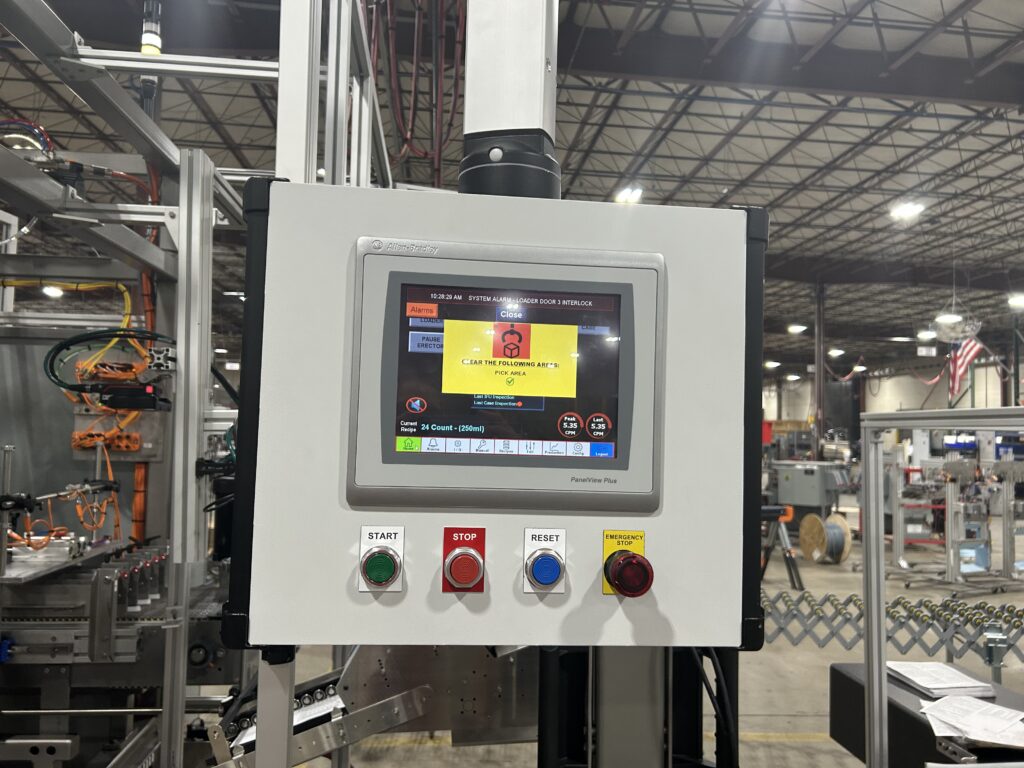
Part of that long-term support includes remote management and monitoring, engineered into equipment before it’s ever integrated into a line.
“We can remote in and make programming changes, but we can also get feedback on cycles and preventive maintenance and send all that information to the customer,” said Mitchell.
RESEARCH | The New Remote Management Mindset in Packaging: Smart, Scalable, Secure Service
With these capabilities, Combi can track increases in torque in a motor or predict potential failures on a gearbox or bearing and advise the customer on any necessary equipment adjustments. All of this is accomplished without stepping foot on site.
Supporting customer uptime, in-house
Supporting that long lifecycle is a broad service and equipment portfolio, along with the tools designed to help customers maintain uptime, including Combi’s spare parts business based in its Canton facility.
“There’s $6 million of on-hand inventory that supports a $9 million spare parts business and a $32 million equipment business,” said Mitchell.
That support extends into in-house capabilities such as 3D printing, which was added out of necessity after supply chain disruptions occurred during the COVID-19 pandemic.
“We have technology here, such as a 3D scanner and a 3D printer that we can actually get the exact profile of a bottle and design our own grippers,” said Untch. “I would say we probably lean more towards making them ourselves.”
That same hands-on approach carries over into how Combi builds its workforce.

Curating the next generation of machine builders
Combi’s workforce is closely tied to Ohio’s manufacturing base, with many employees bringing hands-on experience from fabrication and skilled trades. That background shapes how the company recruits and trains its workforce.
“They’re the fix-it guys. They come from a fabricating background. We have some welder fabricator fitters that we turned into machine builders,” said Mitchell.
Combi continues to recruit problem solvers in the Rust Belt and build technical capabilities internally, while also working with nearby schools to maintain a steady pipeline of talent.
“We find that fit, the person who has that mind to create that fitter, that fabricator, the problem solver,” said Mitchell.
That hands-on, problem-solving mindset carries into daily operations, where employees learn from each other and take ownership of their work, while embracing connected technologies.
“There’s a lot of old guard, so to speak, that’s retiring,” said Guritza. “We’re bringing in new folks that are more from the information age, where data, speed, and accuracy matters.”

Evolving with the industry
Combi’s foundation continues to shape how the business approaches innovation and long-term growth.
“We are not gathering moss at all. We are growing. We are leaning into the idea of anything in and around innovation,” said Guritza.
He pointed to broader industry and economic shifts, such as tariffs, as drivers for change.
“I think we are at a point of influx in the world, in our country, and what got us here isn’t going to get us there,” he said.

That mindset is influencing how Combi approaches both engineering and partnerships.
“I think the innovations and the technological advancements with a lot of our supplier partners dovetailed with our vision and our experience really positions us very uniquely in the market,” said Guritza.
For Combi, the focus is less about a single technology and more about continuing to evolve how it designs and delivers custom end-of-line systems.
Back on the production floor in Canton, that approach shows up in every machine moving through the assembly bays.
“It’s not just assembly. It’s truly machine building. There’s a lot of art and science mixed into it to create a custom solution,” said Mitchell.

Subscribe to the Packaging OEM newsletter
Get the latest news, trends, and technology updates delivered straight to your inbox and make smarter packaging decisions.