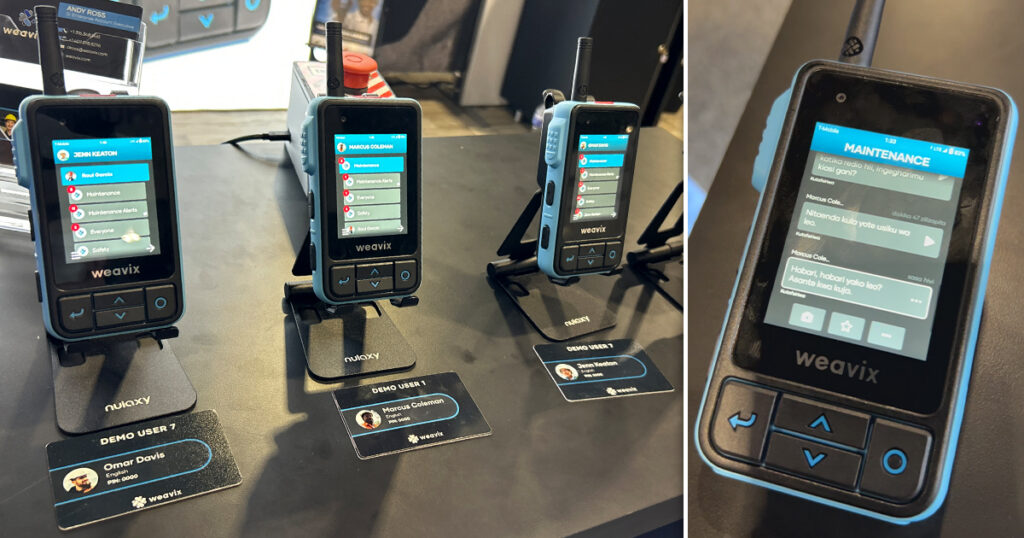
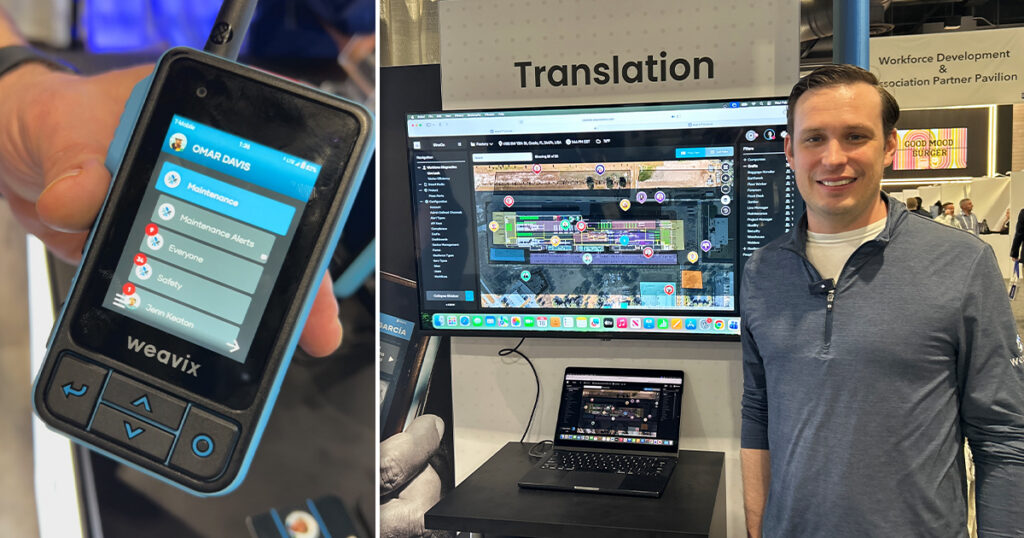
Weavix demonstrated its Walt Smart Radio at Pack Expo East in Philadelphia, a communication device designed to connect frontline workers across multilingual packaging and manufacturing operations.
Using artificial intelligence (AI)-powered translation technology, the device enables instant communication between workers. From English to Spanish and even Swahili, the system can translate more than 40 languages right in the palm of your hand.
“Our mission is to connect every disconnected worker,” said Ben Burrus, chief innovation officer at weavix, during an interview with Packaging OEM. “We do that through our proprietary hardware.”
AI translation bridges language gaps
To demonstrate, Burrus pulled a unit from a charging port and spoke English into the radio as another device translated his message into Spanish.
“You can do group and one-to-one channels. This really lets you include every single worker,” said Burrus. “This kind of breaks down those barriers and makes sure that all of your workforce is included.”
RESEARCH | Smarter Packaging Operations With AI
The device offers unlimited channels, connecting the workforce as a group or through one-to-one conversations, while translating when needed.
“By far, Spanish and English are the most popular,” said Burrus. “If there’s a small group of people that speak the language, it’s just as important.”
He added that weavix works closely with facilities to ensure workers can use the technology to communicate, citing an example of a pet food plant in Wisconsin.
“They had 14 different languages at their plant. So, Swahili, Albanian, they had Spanish, all these different languages,” said Burrus.
At that same plant, Burrus explained how the technology made a difference for a non-English speaker.
“There was an Albanian gentleman there, and he was actually a trained engineer, but he spoke no English, so they just had him as a laborer,” he said. “He was able to actually use our product to get promoted and use his skills.”
Smart radio replaces phones on the factory floor
The Walt Smart Radio runs on the company’s proprietary operating system, Walt OS, which limits functionality to work-related tools and communication features.
“It’s a custom OS, so it’s not Android, it’s not iPhone. That means there are no games, there’s no web browser. It’s a purpose-built device for work,” he said.
The approach addresses a growing concern in manufacturing environments where smartphones can create safety concerns, distractions, and unauthorized information capture.
“You avoid those distractions. You avoid intellectual property risks of people taking pictures of your machinery on the floor. It’s a closed system,” he said.
Badge authentication simplifies device access
For operator ease, the device includes authentication and workflow tools. Workers can sign in to any device using a badge-based login system.
“We call it tap and go authentication,” said Burrus. “Each user has a badge. They use it to get in the door already, but they can come and grab any device from a charger, pick it up, tap the badge to it, enter a six-digit PIN, and now it’s theirs for the day,” he said.
That same ease of use carries through to the end of the workday.
“At the end of the shift, all they do is dock it. It logs them out, wipes it, and it’s ready for the next person,” he said. “It’s very easy to deploy.”
PACK EXPO EAST | Amazon Transparency captures the future of 2D barcode traceability
The Walt Smart Radio can also support digital workflows, including custom forms such as work order requests and safety observations. It can also integrate with machinery and other systems to notify workers when issues occur on the plant floor.
Emergency alerts for maintenance and safety
Beyond communication, the Walt Smart Radio can integrate with equipment and plant systems to notify workers when issues occur. Burrus demonstrated this capability by activating an emergency stop button on a machine, which automatically triggers alerts on the devices for maintenance and safety teams so they can respond immediately.
“We do have a full web console, and you can not only see where people are in the plant for safety situations, but you can also send out mass alerts,” said Burrus.
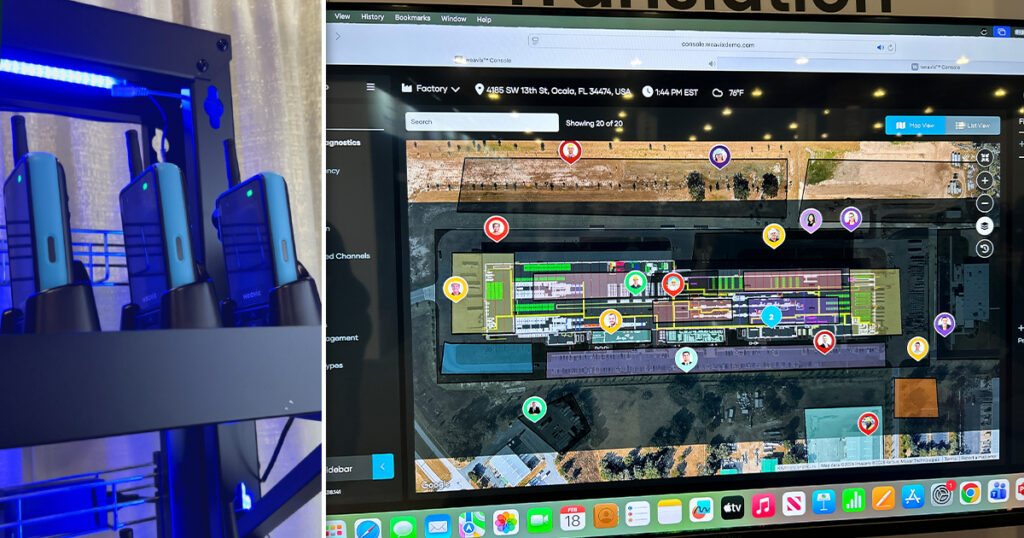
He explained that the technology can work with existing safety systems, helping companies respond more quickly during emergencies.
“We’ve had customers that have taken mustering drills down from 30 minutes to five minutes,” said Burrus.
Burrus said companies such as Hanes, Tesla, Kraft Heinz, and Panasonic have deployed the devices across their plants. He said the technology is designed to bring communication, alerts, and workflows into a single device for frontline workers.
“We’re connecting those disconnected frontline workers,” said Burrus. “We’re creating a digital hub. We’re really taking the radio to the next step.”

Subscribe to the Packaging OEM newsletter
Get the latest news, trends, and technology updates delivered straight to your inbox and make smarter packaging decisions.