The new year is upon us, and so are packaging laws that are impacting machine builders, manufacturers, and consumers alike.
Key updates include new bans on single-use plastics and polystyrene foam containers, also known as Styrofoam. Additional restrictions include Per- and polyfluoroalkyl substances (PFAS) in food packaging, and tighter recyclability labeling requirements.
For OEMs, these changes may affect compliance and opportunities for innovation. Manufacturers need to stay informed to maintain sustainability, ensure safety, and remain competitive. Consumers will see fewer single-use plastics, polystyrene, and harmful chemicals in packaging.
Here are the packaging laws that will be implemented in the United States in 2026:
California: Plastic bag and labeling updates
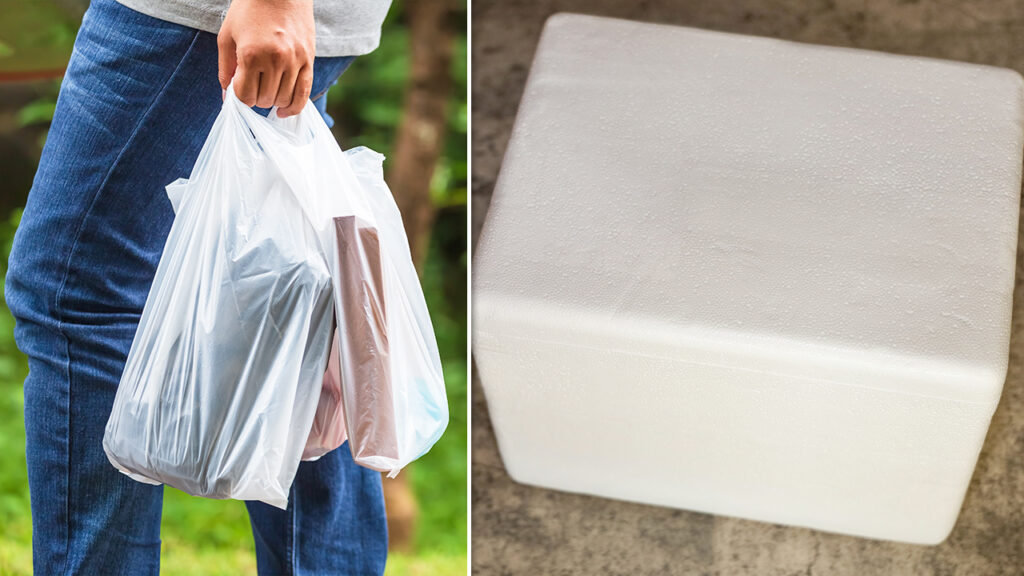
Starting January 1, grocery stores in the Golden State will no longer be allowed to provide single-use carryout bags at the point of sale. Stores can still provide pre-checkout bags, like those used for unwrapped food, or bags that protect purchased items. Under SB 1053, recycled paper bags are still allowed and must be sold for at least $0.10. By 2028, these bags must contain at least 50% postconsumer recycled content. The bill also eliminates earlier reusable bag certification rules.
“The plastic bag prohibition at grocery store checkouts will eliminate millions of plastic bags from our waste stream, and using paper bags, when you don’t have a reusable one, is a more renewable and recyclable resource that doesn’t require drilling for oil in its creation, as plastic bags do,” said California state Senator Catherine Blakespear (D-Encinitas), author of SB 1053, in a December 2025 statement.
Additionally, under SB 343, California will enforce restrictions regarding recyclability claims on packaging. Beginning October 4, 2026, products and packaging manufactured after that date cannot use the chasing arrows (recycling symbol) or other recyclability labels unless the material is collected and processed for recycling in California, based on CalRecycle data. The law is intended to prevent misleading recycling claims.

“A product is not ‘recyclable,’ and should not be advertised as such, if it cannot be recycled,” said California state Senator Ben Allen (D-Santa Monica), author of SB 343, in a January 2026 statement.
Illinois: Hotel bottle restrictions
The small single-use bottle act (SB 2960) now applies to all hotels in the Prairie State as of January 1. The law prohibits hotels from providing small, single-use plastic personal care bottles that are under 6 ounces and are not intended to be used more than once, such as shampoo and lotion. The legislation first took effect in 2025 for hotels with 50 or more rooms and has now expanded to all hotels statewide in 2026.

Maine: Chemical restrictions for food packaging
The Pine Tree State’s food packaging law (Public Law c. 277) continues to restrict chemicals of concern in food packaging sold in the state.
Beginning May 25, 2026, Maine will prohibit the use of PFAS in certain food packaging intended for direct food contact. This includes paper- and fiber-based items such as bags, bowls, clamshells, trays, pizza boxes, wraps, and liners.
The legislation applies to packaging used for short-term storage or freshly prepared food. Food and beverage manufacturers with less than $1 billion in annual sales are exempt.
Minnesota: Compostable labeling requirements
Beginning January 1, all products sold in the Gopher State that are labeled “compostable” must be certified by the Biodegradable Products Institute (BPI), a nonprofit third party, under Minn. Stat. § 325E.046. The law applies to bags, packaging, and food service products such as plates, trays, cups, bowls, to-go containers, utensils, and straws.
According to the Minnesota Pollution Control Agency (MPCA), covered bags must be made only of wood or paper, with no additives or coatings, and must meet industrial composting specifications. Manufacturers, distributors, and wholesalers may not sell non-compliant products in the state.
New York: Polystyrene cold storage container ban
Effective January 1, no manufacturer, food service provider, or store in the Empire State can sell or distribute expanded polystyrene containers for cold storage. This includes coolers and ice chests, unless they are fully encapsulated in a more durable container. There are exemptions for raw meat, prepackaged food, drugs, and medical devices. Also, the New York Department of Environmental Conservation said the law does not apply to New York City.
“Expansion of these restrictions will further benefit New York State residents and the environment and will encourage a switch to container and packaging options that are reusable, recyclable, and compostable,” said Amanda Lefton, commissioner of the New York Department of Environmental Conservation, in a statement.
The legislation builds on the 2022 statewide ban on single-use polystyrene food service containers and packing peanuts.
Virginia: Expanded polystyrene food container ban
Effective July 1, 2026, Virginia’s ban on polystyrene food service containers, including cups, primary packaging, and foam products, will expand to all vendors in the state. Localities may grant one-year exemptions for vendors “demonstrating economic hardship.”
The ban is also applicable to Virginia schools.
Washington: Single-use plastic bag fee updates
Beginning January 1, retailers and restaurants in the Evergreen State must charge 12 cents for plastic carryout bags and 8 cents for paper bags under ESHB 1293. Businesses providing plastic carryout bags with film thickness that is 4 mil or more must collect an additional 4-cent penalty, for a total of 16 cents per bag, through December 31, 2027.
“The requirement for reusable plastic bags to be 4 mils thick is delayed from Jan. 1, 2026, to Jan. 1, 2028. Until 2028, the current minimum of 2.25 mils remains in place,” said the Washington State Department of Revenue, in a December 2025 statement.
Preparing for 2026 packaging laws
Machine builders and manufacturers can stay compliant while advancing sustainability and innovation across the packaging industry. Staying ahead of these laws may also influence material selection, labeling strategies, and machine design decisions in 2026.

Subscribe to the Packaging OEM newsletter
Get the latest news, trends, and technology updates delivered straight to your inbox and make smarter packaging decisions.