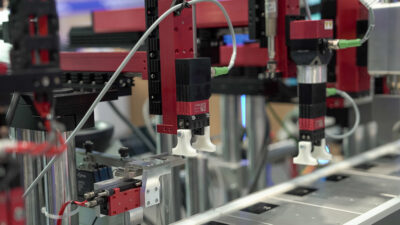
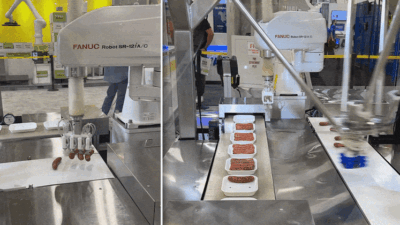
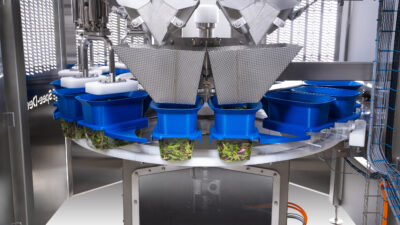
The biggest changes in packaging machinery happen long before a single piece of steel is ever cut. Machine capabilities, powered by artificial intelligence (AI) and digital twins, are shaping how equipment is designed, tested, and deployed across packaging lines.
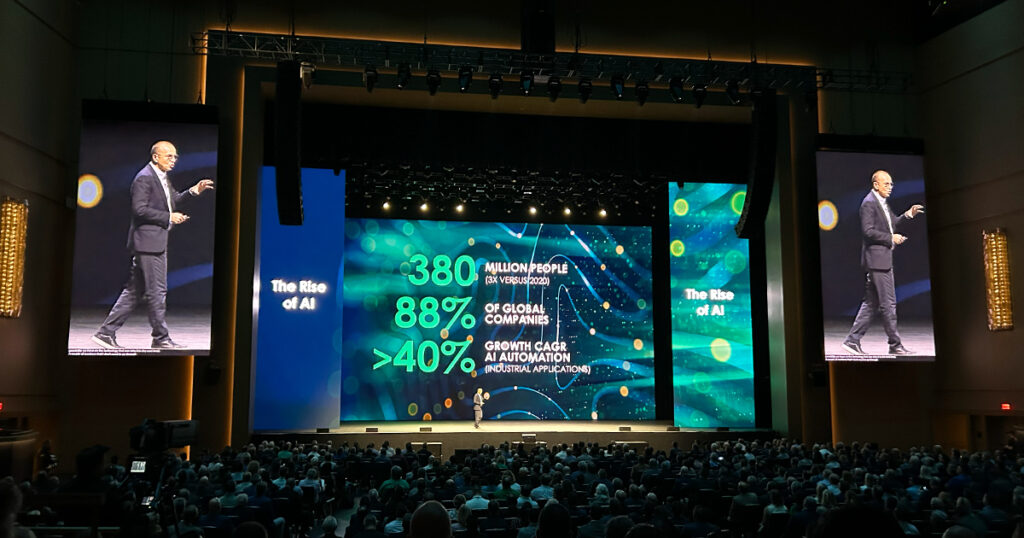
At Schneider Electric’s 2025 Innovation Summit, OEM and robotics experts emphasized that validating performance digitally lets engineers tackle complex packaging challenges, from multiple package types to rising SKUs, before equipment is ever used for production.
“Gone are the days when we shut down the line and do a tool change for eight hours and then start production,” said Christine Bush, director of Schneider Electric’s robotic center of excellence, during an interview with Packaging OEM. “Everything needs to be fluid.”
While the pick-and-place robot may look the same on the floor, its processing capabilities are evolving. Using predictive software and AI-assisted tools that handle vision, timing, and decision-making, packaging machines are becoming not just faster but smarter.
Seeing it all: AI vision in action
AI-powered vision enables machinery to detect and analyze products as they move through the production process. Systems no longer assume package types will behave consistently from cycle to cycle, but instead adjust based on what the machine sees.
“We’re seeing a lot of vision inspection systems out there that can detect and train models to determine if it’s a good product or a bad product. I think that evolves even more,” said Dante Vaccaro, digital transformation consultant for Schneider Electric.
Because packaging sequences move so quickly, timing is critical. Vision data must be processed in real time without slowing production. Edge computing plays a vital role, allowing decisions to be made directly at the machine level rather than being sent to the cloud.
Vaccaro shared an example of this “instantaneous” process model that he saw in a recent packaging deployment, using open, software-defined automation tools.
“We have an edge compute node that’s running EcoStruxure Automation Expert on an industrial PC (IPC) at the edge,” he said. “We train the model in the cloud, deploy it at the edge, and because it’s co-located on a centralized location, we’re able to detect the issue and deploy a programmable logic controller (PLC) output within 10 milliseconds. It’s pretty quick.”
That speed keeps vision-driven decisions aligned with production rates instead of becoming a bottleneck. With continuous data collection, machines refine how they operate from cycle to cycle.
PODCAST | Schneider Electric on open, software-defined automation for packaging
“With all the data being collected, we’re going to have smarter machines out in the field,” said Bush, adding how AI enables pick points, paths, label placements – all without stopping the line or calling for manual interventions.
This intelligence is also being used to monitor stoppages. Rather than generic alarms, machines can pinpoint the sequence step that caused an issue, providing clarity for operators and speeding recovery.
“The machines will be able to say, ‘You know what? In two weeks, I need to go down for a repair, and these are the items that need to be addressed,’” said Bush. “That’s where we’re headed – future state: no more run-to-failure.”
Flexible formats, intelligent motion
Flexible packaging, a format rising in popularity due to consumer convenience and sustainability benefits, is one of the clearest examples where AI-powered vision intelligence becomes essential.
The qualities that make this format efficient downstream – including its lightweight nature and lower transportation costs – create unique challenges at the beginning of the packaging process. Bags shift, product settles, and weight moves as packages travel along the line. A top-down view from a vision system may show a clean rectangular bag, but the contents don’t always maintain a uniform shape.
“When you have a bag of cereal, or rice, or a poly bag with a hard object, it’s very hard to determine the best way to pick it up,” explained Bush. “That’s where artificial intelligence comes in. It consistently looks at the package, identifies where the best pick point is, and determines whether you’re using a suction cup or fingers. It’s constantly having to make small adjustments.”

Adaptable hardware is needed for this packaging type, according to Greg Magdanz, vice president of OEM sales at Schneider Electric. “From an efficiency standpoint, you’ve got to be able to standardize on some type of end effector that’s not going to have to be changed out for every little change you make on the line,” he said. “Packages change. It’s not just a square box. It’s a bag, and that bag gets a little wonky.”
Precise motion is equally important. Vaccaro noted that Schneider Electric’s Modicon M660 motion controller can handle 300 coordinated axes on a single drive. “Pretty powerful little controller,” he said. “It’s like the Ferrari of motion-centric and servo control.”
RESEARCH | Food Packaging: A Flexible Future and the Shelf-Ready Revolution
Once they’re moving through the system, this format doesn’t always behave predictably.
“We always say the hardest thing is when you have a poly bag, it can look like a nice rectangle, and then the product can be a bowling ball,” said Bush.
This forces equipment to adapt in real time. By integrating AI, the system adjusts because it recognizes what it’s seeing and updates accordingly.
Simulating success: digital twins in packaging
Digital twins are becoming essential for machine builders, allowing them to validate system behavior long before physical assembly. Instead of waiting for the first prototype, engineers can see how a robot moves or how a conveyor loads using computer-aided design (CAD) software, where configurations can still be adjusted.
“We model everything in SolidWorks first,” Bush said. “We model the robot. Then we can put it in place and say, ‘Okay, if it’s going to move this way, is it going to hit the machine?’”
PODCAST | Schneider Electric on AI, robotics, and digital twins in packaging
In one project, a digital model revealed an issue that would have been expensive to uncover later. “In the first design, the robot was going to hit the sidewall,” said Bush. “We were able to say we either need a different [robotic] arm or a different design.”

Because the collision was caught in simulation, it became a design adjustment rather than a system rework, and it occurred before any physical build work began.
“They’re going to save a ton of money by using digital twin software, as opposed to building up prototypes,” said Magdanz. “I think more and more customers are realizing that they need this technology. They need to figure out how to implement it.”
READ MORE | Designing the next-generation more sustainable package
These digital replicas support product movement as paths, timing, and pick locations that can be optimized long before a system ever reaches the plant floor. As applications grow more varied and accuracy expectations rise, these digital validations are becoming part of the buying process, not just engineering.
“If an OEM does not have a digital twin, the end user is going to look for another builder with a similar machine type where they do have a digital twin,” said Bush. “It’s going to be very important for them to use digital transformation in their facilities.”
Built to think ahead
The biggest changes in packaging machinery aren’t always visible on the line, but they are shaping how equipment is designed, validated, and deployed. Embedded intelligence is being defined earlier, tested sooner, and expected to perform under conditions once handled manually.
This shift raises urgency for OEMs. Falling behind no longer looks like outdated hardware or slower machines – it’s systems that can’t adapt when conditions or formats fluctuate.
As the scene shifts, Bush left no doubt about what’s at stake. “OEMs that don’t invest in this type of technology will be the next Blockbuster or Nokia,” she said.

Subscribe to the Packaging OEM newsletter
Get the latest news, trends, and technology updates delivered straight to your inbox and make smarter packaging decisions.