When it comes to using robotics in the warehouse, the one thing everyone can agree on is the promise of physical artificial intelligence (AI), which enables autonomous machines to perceive, understand, and adapt to changing conditions in the real world.
The promise is there, but the presence of physical AI is not as prevalent.
“There’s been a lot of progress in robotics in the last few years, and physical AI is now a very popular term,” said Omar Asali, chairman & CEO of Ranpak, a provider of sustainable packaging systems. “I think the biggest issue that we see is that, frankly, deployment at scale and mass adoption has not occurred…I think the promise looks great. There’s a lot of beta testing and alpha testing, there’s a lot of demos, but real mass adoption has not occurred yet.”
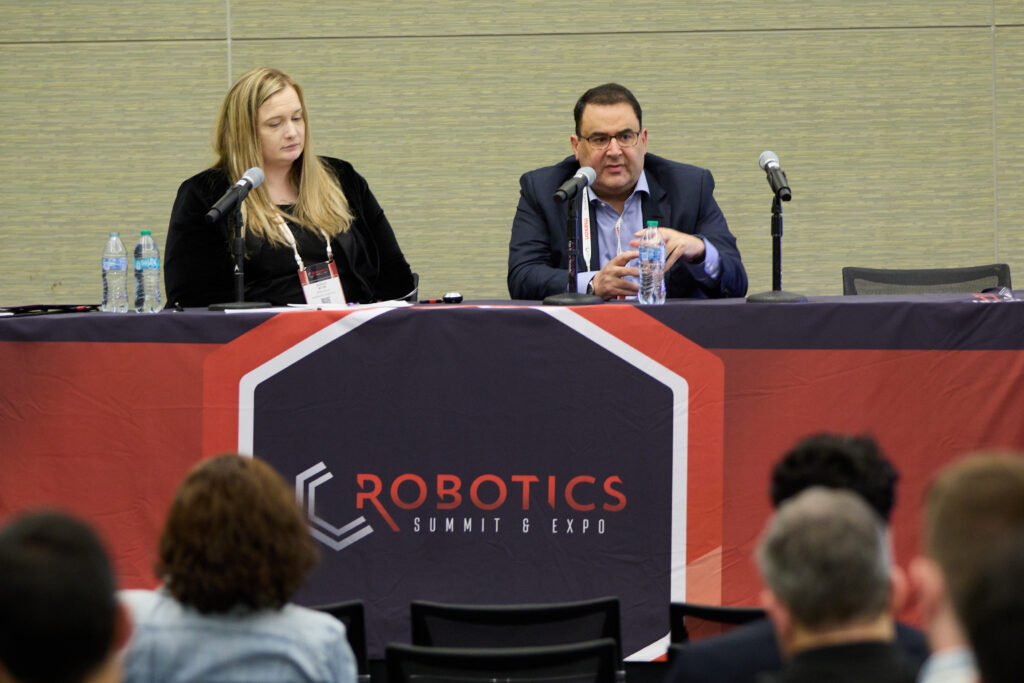
Asali outlined the progress and challenges associated with robotics in the warehouse during an interview with Packaging OEM senior editor Sarah Wynn at the Robotics Summit & Expo in Boston last month. In this conference session, which focused on how physical AI is driving profitable and scalable sustainability in warehouses, Asali covered a range of issues, including the need for better data coordination, the potential of AI in predictive maintenance, as well as a future where more automation drives tangible ROI and efficient use of resources.
Mobility vs. manipulation
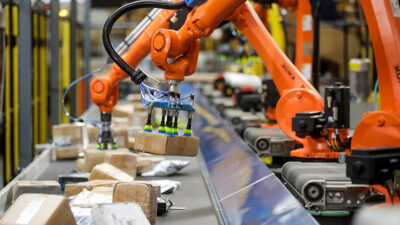
At Ranpak, the company uses large robotic arms for palletizing and de-palletizing. In addition, Asali said one of the investments that the OEM has made is in Pickle Robot Co., a robotic pick-and-place application for loading/unloading packages in the warehouse. Pickle Robot uses pre-trained models to create generative AI applications specific to the logistics domain that can work at human – or even better-than-human speed.
While many of the robotic deployments in a warehouse are autonomous mobile robots (AMRs) that transport goods from one point to another, the ability to manipulate goods vs. move them is an important distinction for robot applications in the warehouse.
“The piece around mobility is more advanced than the piece around manipulation, so I think there’s a little bit more scale there, and you see that in deployments,” Asali said. “I think the manipulation piece has been harder.”
RESEARCH | Robotics on the Packaging Line: Enabling Faster, More Flexible Operations
Asali noted that the biggest reason why robot-enabled manipulation hasn’t been deployed is twofold: First, a lot of companies have promised capabilities that will generate certain ROI that have not materialized, which impacts future deployments. Second, the issue is not that robots cannot do something in terms of capabilities, because robots can do a lot. The issue is doing it in a way that generates the right ROI and payback for customers. “I think that’s the question that hasn’t been answered satisfactorily,” he said.
And, many of these robots are task-specific deployments that are less likely to scale. But you have to start somewhere, and eventually these application-specific robots will evolve to more multitasking systems.
“This is no different than when Amazon started as a book business and became an e-commerce machine. But they needed to do the book business first to perfect billing, logistics, and the customer experience and then expand,” Asali said.
Despite the progress, Asali said there remains a gap between what the technology is capable of and what has been deployed at scale. “The pace of innovation versus the pace of deployment, there’s a disconnect,” he said.

Subscribe to the Packaging OEM newsletter
Get the latest news, trends, and technology updates delivered straight to your inbox and make smarter packaging decisions.
AI making data-based decisions
In response to the Amazon analogy, Packaging OEM’s Wynn asked Asali for practical examples of how robots can help fill the ROI gap and even add value in the future. The short answer: data.
Ranpak’s DecisionTower is a vision system that uses AI to detect out-of-scope boxes to optimize packing and prevent machine stops, thereby helping the uptime of equipment. For example, DecisionTower can look at the flow of boxes coming in, and if there’s an overflow or issue of some sort, the vision system will indicate that the parcels need to be diverted rather than move to the equipment.

And in the future, the focus is on better orchestration and coordination of the data that companies have in different systems.
“We work with some of the most sophisticated companies in the world, and we get their data from their warehouse management system, and what’s shocking is how poor that data is, how inaccurate it is,” he said. “So even today, as we talk about AI, we live in a world where the data that we’re all using still can be improved significantly. And I think over time, as we automate more of these tasks, I think we’ll see quite a bit of improvement in data integrity and accuracy, which will be self-fulfilling in making robots even more effective.”
PHOTOS | Cobots, humanoids, and AI-powered automation at the Robotics Summit & Expo
To help solve some of these problems, Ranpak has been using AI to make its own equipment better. To that end, the machine will respond to the operator through the company’s Connect.IQ suite. Literally, workers could talk to the equipment if there’s an issue and then get feedback from the machine in terms of what the potential issue is and how to service it. That then means the machine operator spends less time talking to Ranpak service technicians and more time solving problems.

“We’re doing a lot of data analysis work for preventive maintenance and predictive maintenance,” Asali said, noting it will not only help with equipment uptime but also overall productivity. “The equipment is just becoming smarter in an industrial setting to bring efficiency to the customer.”
And, eventually, using physical AI, that efficiency will scale across the warehouse.