During 2025’s ProMat and LogiMAT trade shows, automated packaging began to move to the forefront of the warehouse automation conversation. Robotic packaging systems were becoming more visible, not only through larger booths and increased presence at these events, but also of early collaboration and integration between packaging vendors and the broader warehouse ecosystem.
In our “End of Line & Warehouse Packaging Automation” report, Interact Analysis noted that packaging vendors were starting to align more closely with system integrators and warehouse solution providers, suggesting that these technologies will play a larger role within end-to-end automation strategies.
One year on, that transition is now much clearer.
From visibility to implementation
At Modex 2026, the number of automated packaging systems on display increased significantly, with a broader mix of vendors targeting warehouse applications, reflecting growing interest.
More importantly, the way these systems are now positioned has changed.
Rather than focusing solely on machine performance, vendors are increasingly promoting their systems’ ease of implementation. Messaging has shifted toward plug-and-play deployment, modular design, and seamless integration with existing warehouse systems. The value proposition is now focused on easy incorporation into broader operations.
CMC and Packsize, two of the largest providers of packaging machines globally, both used recent trade shows to demonstrate how their solutions can operate more easily within broader warehouse environments.
At both Modex and LogiMAT, CMC demonstrated how its offerings can operate within connected warehouse workflows. This included demonstrating integration with AutoStore, one of the more widely adopted automated storage and retrieval systems (ASRS) in e-commerce fulfillment.
It expands on CMC’s Pick2Pack concept, a workflow that connects order picking directly to right-sized packaging, reducing intermediate handling steps and manual intervention. By demonstrating packaging as one step within a broader automated flow, CMC is positioning its systems as part of the natural flow of goods, rather than a bolt-on value add.
To a similar end, fellow right-sized packaging machine builder Packsize has been actively expanding its relationships with system integrators. The company recently announced partnerships with Bastian Solutions and Hy-Tek Intralogistics, two of the larger warehouse automation integrators in North America.
At Modex 2026, the company held live demonstrations of box-last packaging capabilities acquired through its 2025 purchase of Sparck Technologies. The demonstrations allowed attendees to bring in their own items and run them through the system on the show floor, a signal of confidence in the machine’s reliability and ease of use. The aim was to provide evidence and deliver a clear message to integrators and prospective partners that the solution is reliable and simple to use.
Taken together, these developments point to a broader competitive shift. As packaging automation becomes a more common part of end-to-end warehouse projects, vendors are increasingly competing, not only on packaging capability, but also on how easy they are for system integrators to work with.
Integration complexity is a limiting factor
One of the key drivers behind this shift is the increasing importance of ease of integration.
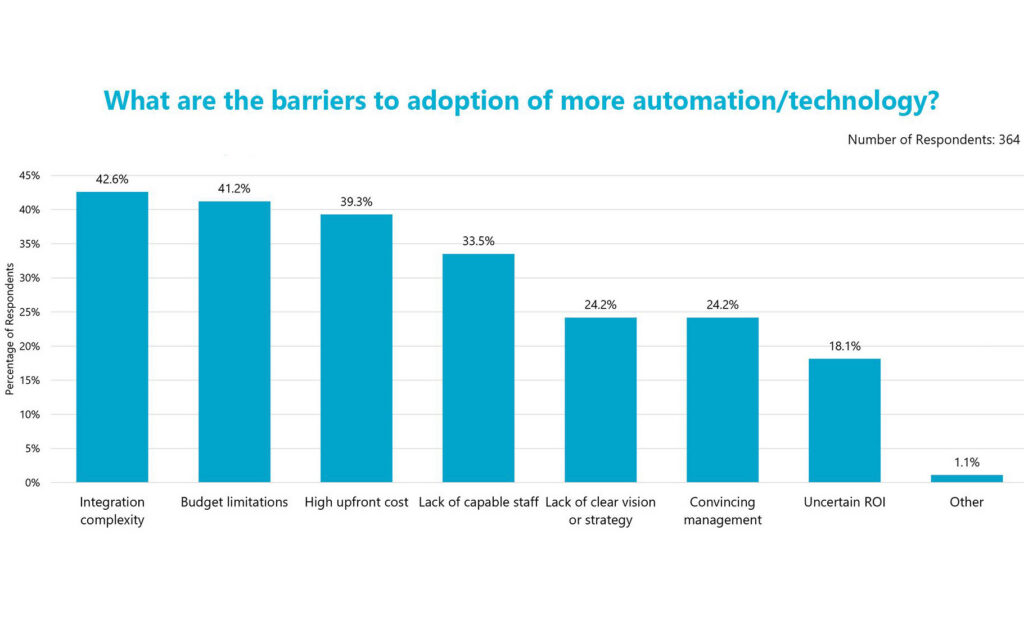
Data from our recent “Voice of Market – Order Fulfillment” study highlights integration complexity as the top barrier to adopting more automation/technology, ranking above both budget and staff constraints. This suggests that for many operators, the challenge is no longer deciding whether to invest in automation, but how to successfully implement it within existing environments.
This is particularly relevant for packaging. Unlike more self-contained systems, packaging must connect across multiple layers of the warehouse, interfacing with upstream picking processes, warehouse control systems (WCS), and operator workflows. As automation expands across the facility, ensuring these systems work together seamlessly becomes more complex.
As a result, integration is no longer a secondary consideration. It is becoming a central requirement for adoption and vendor selection. More broadly, this reflects a shift in how automated packaging is positioned within the warehouse. The conversation is no longer just about adding automation, but about how easily that automation can fit into a wider operation.

Implications for the market
Ease of integration is becoming a key differentiator between packaging vendors, particularly as system integrators play a growing role in shaping warehouse automation projects. As integrators are often responsible for designing and implementing end-to-end systems, their preferences and requirements can significantly influence which solutions are ultimately selected.
In this context, packaging vendors that can offer simpler deployment, stronger compatibility with existing systems, and lower implementation risk are likely to be better positioned to win projects. As a result, differentiation in packaging machinery is no longer based solely on machine capability, but increasingly on how effectively these systems can be integrated into broader warehouse operations.

Subscribe to the Packaging OEM newsletter
Get the latest news, trends, and technology updates delivered straight to your inbox and make smarter packaging decisions.