Artificial intelligence (AI) continues to be one of the most discussed topics across packaging and manufacturing.
But there’s a shift. The conversation around the technology is evolving from experimentation to implementation – and how it can create value on the packaging line and in the warehouse.
This week, we’re looking at how OEMs and companies are approaching that challenge through edge computing, physical AI, and data strategy.
We also spotlight recent AI discussions from the Robotics Summit & Expo in Boston.
Want early access to our curated On the Line newsletter? Email subscribers get this info every Tuesday. Click here to sign up.

Subscribe to the Packaging OEM newsletter
Get the latest news, trends, and technology updates delivered straight to your inbox and make smarter packaging decisions.
Living on the edge: Bringing AI closer to operations
As packaging lines produce more formats and warehouses handle more products, AI is taking on a larger role in operational decision-making.
The challenge is no longer collecting data – it’s turning that information into faster decisions on the floor.
Toyota Automated Logistics outlined how edge computing is helping organizations process information closer to where work happens, supporting applications ranging from pallet inspection and robotic picking to overall orchestration.
Ultimately, enabling warehouses to move toward more responsive operations.
“AI in the warehouse is basically the bridge from automation to autonomy,” said Chris Morgan, senior director of R&D at Toyota Automated Logistics. “It gives us all a competitive advantage.”
→ Read the full story

Physical AI meets deployment reality
Physical AI continues to generate buzz across robotics and packaging, but widespread deployment remains a work in progress.
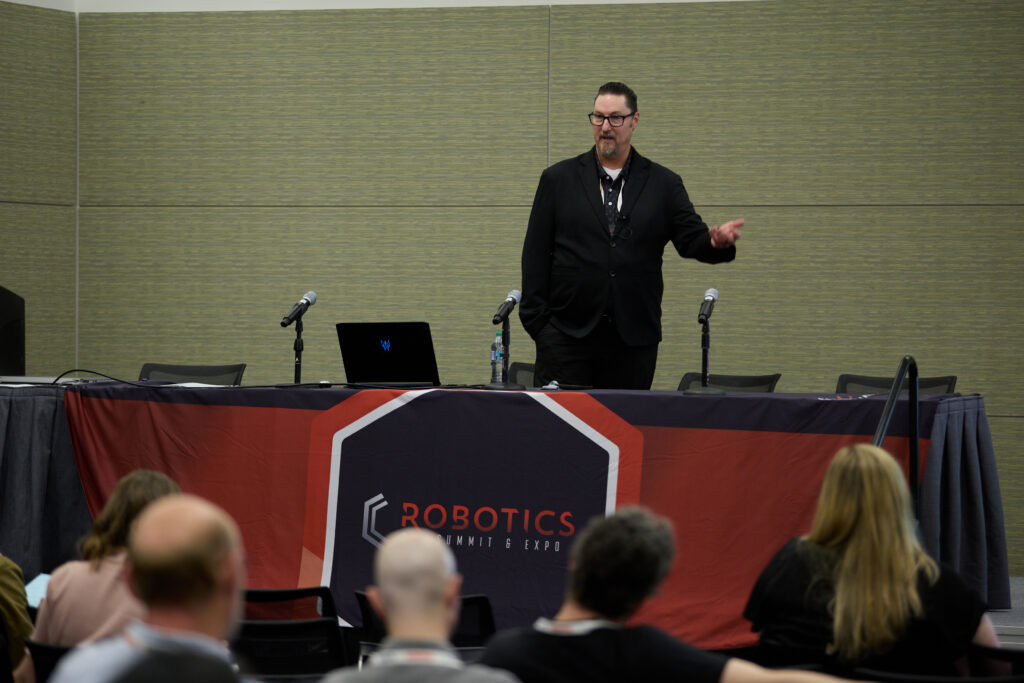
At the Robotics Summit & Expo, Packaging OEM moderated a conversation with Ranpak CEO and chairman, Omar Asali. He explained the challenges associated with scaling physical AI and why the gap between promise and deployment still exists.
“I think the biggest issue that we see is that, frankly, deployment at scale and mass adoption has not occurred,” said Asali. “I think the promise looks great. There’s a lot of beta testing and alpha testing, there’s a lot of demos, but real mass adoption has not occurred yet.”
→ Read more
Adapting robotics to changing packaging requirements
In a world with increasing formats and SKUs, lines rarely run a single product forever.
Last fall at Pack Expo Las Vegas, PAC Machinery demonstrated how AI-enabled robotics and vision technologies are helping automate bagging applications while adapting to changing packaging requirements.

“Packagers are looking at different types of packaging materials, and they want to future-proof their investment in automation. They want machines that are either material agnostic or will allow them to work with whatever’s the next great paper,” said Greg Berguig, president of PAC Machinery.
Rather than replacing traditional automation, AI is increasingly being used to help robotic systems handle variability across packaging operations.
→ Learn more
25 photos from Robotics Summit & Expo
Humanoids, collaborative robots, components, and more.
We captured some of the technologies, people, and conversations shaping this year’s event in Boston.
→ View the gallery

The hidden challenge behind AI deployment
AI is only as effective as the data behind it.
Our report dives into how companies are approaching data collection, storage, and integration as they build the foundation for AI-driven operations.
→ Download the report

Final takeaway
The promise of AI is exciting and easy to understand.
The harder part is deployment – connecting data, integrating systems, and identifying applications that solve real-world operational challenges.
That’s where many of the conversations across packaging, material handling, and manufacturing are headed.