The National Retail Federation’s annual NRF show brought packaging and supply chain technologies into the spotlight last week in New York City.
Key themes centered on artificial intelligence, 2D barcodes, radio frequency identification (RFID) technology, and product data, according to Teresa Williams, strategic account director at GS1 US, the nonprofit organization behind the barcode.
Williams spoke with Packaging OEM after the event wrapped to share what stood out to her.
“The scale was immense,” she said. “There was a sea of 40,000 retail innovators representing 5,000 global brands, 100 different countries, and more than 1,000 exhibitors.”
Leveraging AI for real-world impact
Williams said that innovation and collaboration are familiar themes at NRF, but the thing that stood out most to her was how AI has moved from concept to real-world use.
“We’re not just talking about the different concepts anymore,” she said. “We’re seeing real-world applications. We’re seeing this really transform.”
RESEARCH | Smarter Packaging Operations With AI
Many of those applications, she added, focused on how data is generated and used across physical products.
“A cool concept that we saw was from Wiliot,” said Williams, referring to the IoT company’s Gen3 IoT Pixel battery-free sensor, which made its debut at NRF.
According to Wiliot, the sensor is designed to be small yet deployable at large scales as it enables products and assets to emit data as they move through the supply chain. That information supports ambient IoT, which enables physical AI applications in logistics and retail.
“Not only are you getting location information, but you’re also getting temperature and humidity,” said Williams. “It’s a huge game changer for cold chain traceability.”
2D barcodes and RFID: Smarter packaging in motion
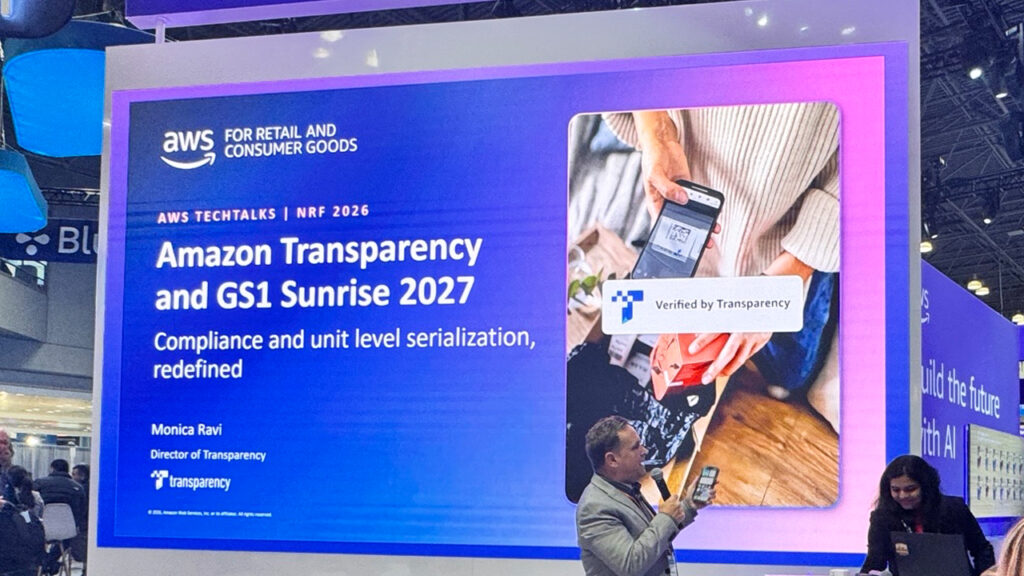
On the horizon for GS1 is Sunrise 2027, the industry’s date to transition to accepting 2D barcodes at point-of-sale systems.
2D barcodes resemble QR codes and can carry significantly more information than traditional 1D barcodes. This allows manufacturers to embed details such as expiration dates, batch numbers, and allergen information within a product’s barcode for consumers to access on their smartphones.
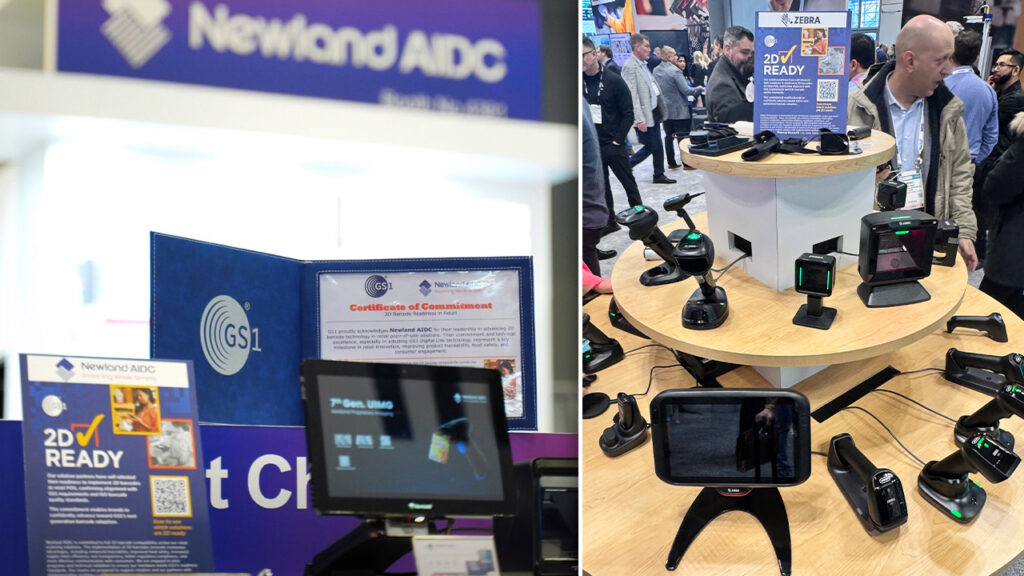
Williams said NRF highlighted how 2D barcodes can hold much richer product information.
“That shift from 1D to 2D is so huge because the 2D barcode is really going to enhance the consumer experience along the supply chain,” she said. “It’s going to help you meet regulatory standards because it just holds so much more data.”
WEBINAR | Smart Packaging for the Beverage Industry
While 2D barcodes expand the data carried on the package, RFID extends that information beyond the package into the supply chain.
“We saw some really great RFID technology at our Zebra [Technologies] partners around smart fitting rooms and their relationship with Lowe’s to use RFID to combat retail crime,” she said.
Across retail and supply chain environments, Williams said RFID is being used to support automation and provide real-time inventory insights.
“The utilization of RFID was huge in automation,” she said. “The richer data, being able to replenish more quickly with information that’s provided in real time, that was a big focus.”
This combination of 2D barcodes and RFID supports more responsive operations across packaging and supply chain environments.

Subscribe to the Packaging OEM newsletter
Get the latest news, trends, and technology updates delivered straight to your inbox and make smarter packaging decisions.