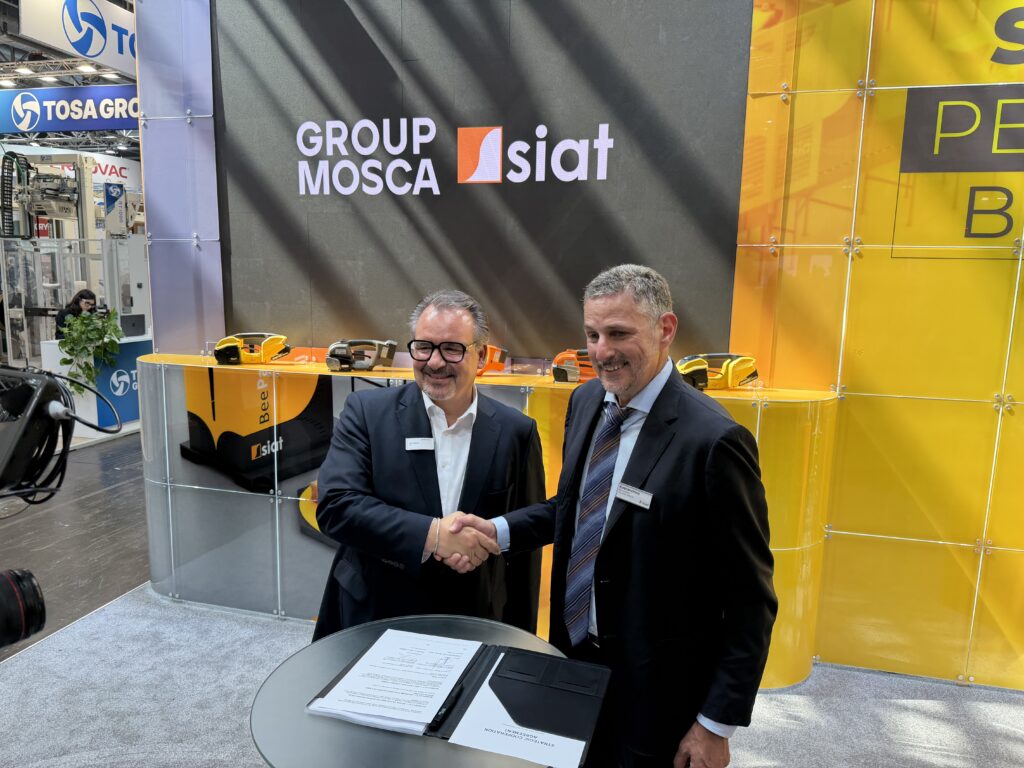
Siat Group and GroupMosca announced a strategic cooperation agreement on Thursday at Interpack 2026 in Düsseldorf, Germany. The collaboration brings together both companies’ packaging equipment and support operations.
Siat Group, which operates both the Siat and Combi Packaging brands, builds machinery for hand strapping, case handling, wrapping, and palletizing applications. GroupMosca specializes in strapping equipment and integrated end-of-line solutions.
The agreement includes shared service, spare parts, training, and remote management capabilities aimed at supporting uptime and keeping packaging lines running across global operations.
Through the partnership, GroupMosca will offer Siat and Combi-branded equipment across Europe, North America, and other select regions. Siat will expand its portfolio, adding GroupMosca strapping and wrapping systems under the Siat brand.
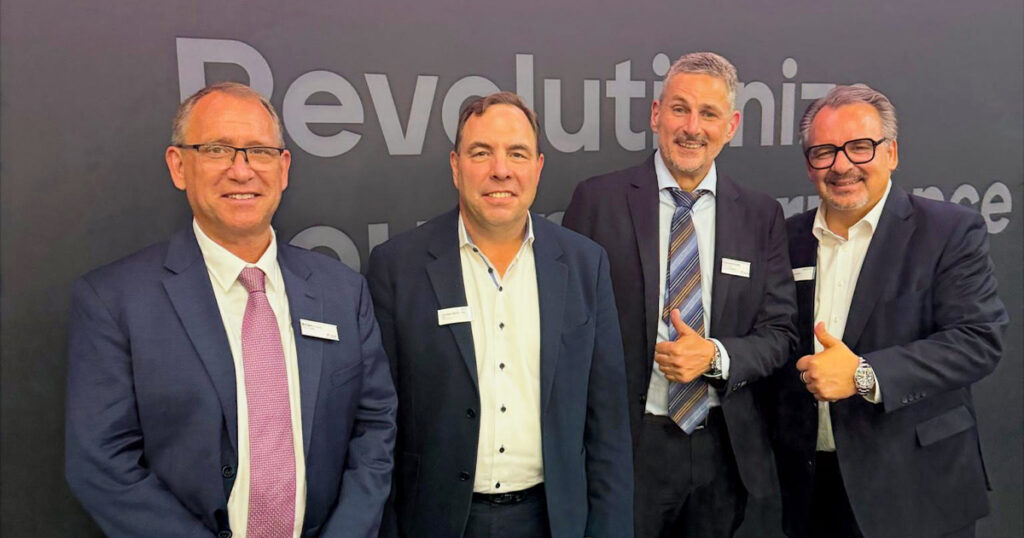
Moments after sharing the news on the show floor, executives from Siat and GroupMosca joined Packaging OEM for a virtual interview to discuss the collaboration.
“We’re announcing a multi-level, multi-country, very ambitious cooperation – a partnership based upon trust without even having to exchange equity,” said Konstantinos Marinakis, CEO of Siat Group.
End-of-line drives production uptime
Executives said the relationship grew from aligned operating philosophies, complementary equipment offerings, and shared priorities around uptime and support.
Timo Mosca, CEO of GroupMosca, said that the collaboration also grew from a strong cultural and business fit between the two organizations.
“We saw that we fit together – not only in our markets and philosophy, but also in the people doing the business,” said Mosca. “So, we decided to make more out of this, which ended up in this partnership.”
Christian Wiethuechter, President and CEO of EAM Mosca Corporation, added that the companies also identified strong alignment across their equipment portfolios and customer support approaches.
“We have very complementary product portfolios, so there’s almost no overlap,” said Wiethuechter. “We also share common values, focused on solid machines, uptime, and have a really good after-sales network.”
The conversation returned to uptime, and the role end-of-line equipment plays in production flow across manufacturing operations.
“Our end-of-line solutions are often behind a whole manufacturing line, very high investment, and these lines run at high or medium speeds. Every element of those lines have to work,” said Wiethuechter. “If those end-of-line systems stop working, the entire factory line will stand. This is why we sell uptime, which is not only run for all machines, but the entire production floor.”
RESEARCH | The New Remote Management Mindset in Packaging: Smart, Scalable, Secure Service
From equipment performance to customer expectations, the focus remained centered on overall productivity.
“Our customer at the end wants uptime,” said Mosca. “When it’s not a big deal who is the producer or which machine it is, our end user needs a solution that runs properly. Not only one time, but continuously, 24/7, and this is our focus. We sell uptime to our customers. That is what keeps us different.”
Support extends into service and operations
Marinakis described customer centricity as a core operational principle shared across both organizations. “Service is not only a differentiator. Service is a way of being,” he said. “It’s the core of our operations.”
The agreement also extends to the rest of the organization, including engineering, maintenance, training, and support.
“With such a big footprint in North America, we can have a big working group, combining engineers, maintenance personnel, operators, managers – you name it,” said Marinakis. “I think this is major good news on the collaboration side.”
RELATED | Built around the application: how Combi develops custom end-of-line systems across industries
Wiethuechter said the cooperation also creates opportunities for both companies to expand support capabilities and product access through their respective sales and service channels.
Responding to automation and sustainability shifts
Executives positioned the agreement around broader industry trends impacting production, including automation, sustainability, and globalization.
“We’re facing big challenges, mega trends of automation, sustainability, and globalization, or the need to build bridges,” said Marinakis. “This partnership couldn’t have come at a better time.”
Brian Vincent, president and CEO of Combi Packaging, said the agreement aligns with growing customer expectations around support and operational performance.
“North American customers increasingly demand dependable, advanced, proactive suppliers,” said Vincent. “Siat Group’s innovations, married to Mosca’s class-leading technology and consumables, deliver an unrivaled solution and rapid ROI.”

Subscribe to the Packaging OEM newsletter
Get the latest news, trends, and technology updates delivered straight to your inbox and make smarter packaging decisions.