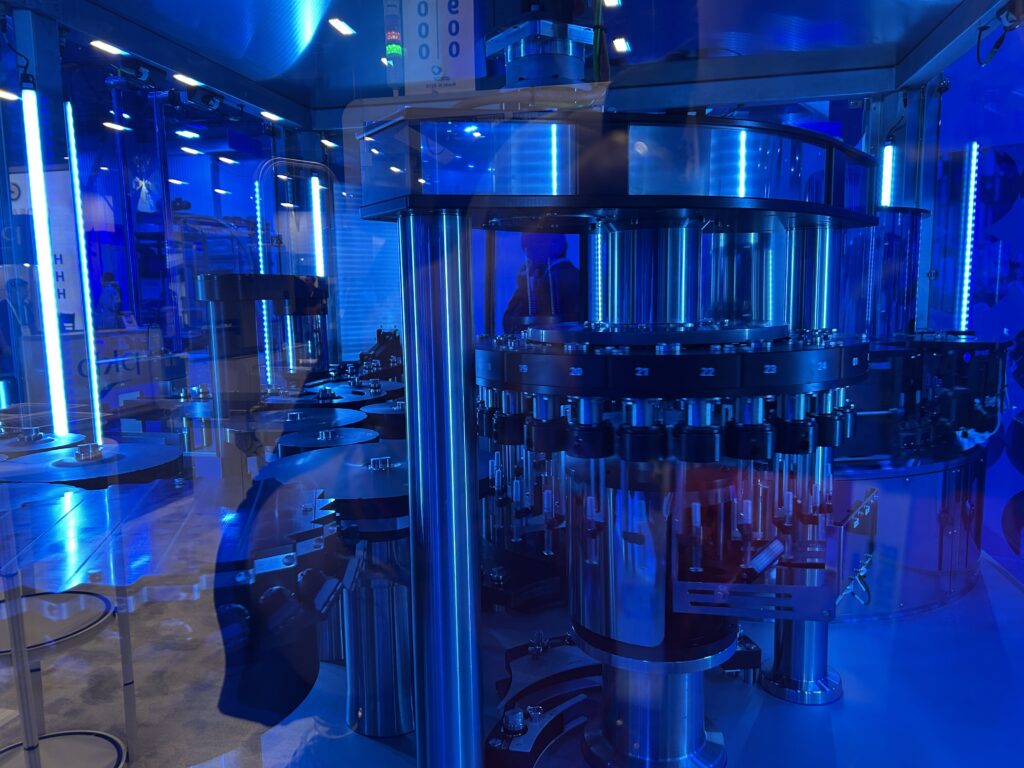
At Pack Expo Las Vegas, Antares Vision Group introduced new artificial intelligence (AI)-driven capabilities to its high-speed visual and leak detection system for prefilled syringes.
The company demonstrated its VRI VI-060S, capable of handling up to 400 glass or plastic units per minute, depending on syringe size, with integrated AI to help operators with recipe management, defect detection, and predictive maintenance.
“Our machines have thousands of parameters inside of them,” said Chris Collins, director of sales at Antares Vision Group, during an interview with Packaging OEM. “They’re very difficult to keep up with and learn, so we’re utilizing artificial intelligence to help facilitate operators and make changes to recipes within a validated state.”
The addition comes as packaging undergoes a steady digital transformation at the same time the pharmaceutical industry shifts product development toward biologics, a class of drugs that most often come in injectable formats, including prefilled syringes. Rising demands have increased the need for accurate syringe inspection and consistent quality control.
AI for inspection and operator support
The VRI VI-060S is a 100% visual rotating inspection and leak detection system that handles syringes with diameters ranging from 6.85 mm to 20 mm. Antares has integrated the system with two layers of AI, with the first being focused on vision to help detect particles, cosmetic defects, flange, and finger-grip issues.
The second layer monitors vibration trends to help operators intervene before potential issues cause downtime. “The AI monitors if there are anomalies in the machine and tells us where to intervene,” said Daniele Ansaldi, technical manager for Antares Vision Group.
RESEARCH | Solving Prefilled Syringe Challenges with Technology
The system features a main carousel for individual product handling and a secondary carousel that inspects the rest of the syringe surface for container damage, foreign particles, and leaks. AI also helps distinguish bubbles from particulate contamination to improve inspection accuracy.
“We can work with a variety of pharma products. We can go from a water-like product to a viscous and milky product,” explained Ansaldi. “We can recognize the bubble as well, we can get rid of the bubble, so not to reject them, and get a clear inspection.”

Handling improvements for glass and plastic syringes
The system incorporates improvements for syringe handling, including plastic formats, which Ansaldi says are prone to surface damage. “We turn the syringes needle-up, and when it’s time to insert them into the carousel, the system handles them in a way that avoids scratches,” he said.
The machine includes a split-infeed screw setup for smooth operation that also prevents undesired stops and starts. It uses guideless transfers between star wheels to minimize friction and protect container integrity.
Optional features include code verification, optical character recognition (OCR), optical character verification (OCR-OCV), and serialization incorporation.
Antares also offers its Easy TB Manual Visual Inspection Station for smaller batches and secondary inspection operations for prefilled syringes and other pharma containers, including vials, bottles, cartridges, and ampoules.